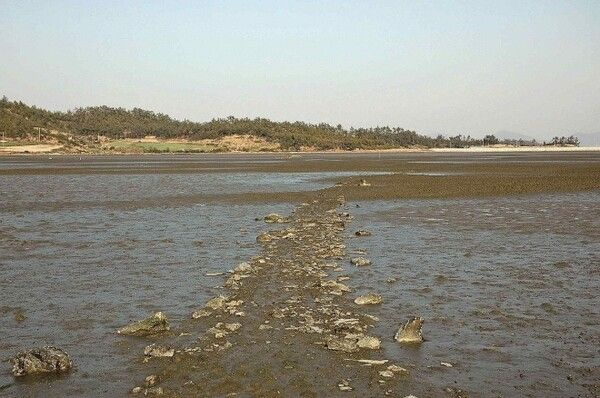
“Multtae,” the traditional knowledge system used by coastal communities to read and interpret tidal cycles, has been newly designated as a National Intangible Cultural Heritage of Korea. Unlike skills held by a single practitioner, it is recognized as a collectively accumulated body of knowledge shared across fishing communities, and is therefore classified as a community-based heritage without a designated holder or organization.
Multtae refers to a traditional temporal framework built upon observing the ebb and flow of the sea. It extends beyond a simple distinction between high and low tides, encompassing the strength of currents, the exposure of tidal flats, and optimal timing for launching or retrieving boats. For coastal residents, multtae has functioned simultaneously as a calendar, a clock, and a practical schedule guiding daily labor.
The designation also finalized its official name. Initially proposed as “tidal knowledge,” the term “multtae” was adopted to reflect its authentic, widely used expression in local communities. As a native Korean term describing tidal change, it encapsulates both environmental awareness and lived cultural practices along the coast.
Historical records trace the concept of multtae back to the Goryeo period, where early awareness of tidal movements is documented. In the early Joseon era, terms such as “yuksu” and “sipsu” appeared in texts, indicating that tidal cycles were already systematized. By the late Joseon period, detailed tidal charts based on a 15-day cycle had emerged, confirming that multtae had become an established and practical body of knowledge. The continuity between these historical records and present-day practices underscores its enduring tradition.
The scope of multtae extends far beyond fishing. It has governed salt production in tidal flats, coastal transportation routes, land reclamation work, and the use of tidal paths connecting islands to the mainland. It also influenced maritime rituals, including prayers for safety and abundant catches. Misreading tidal timing could disrupt livelihoods or even restrict movement entirely, making multtae one of the most essential forms of practical knowledge for coastal communities.
Regional variations further highlight its cultural richness. While many areas count tidal cycles numerically, such as “one tide” or “two tides,” others use distinct local terms like “ma,” “mae,” or “musae.” These variations reveal subtle differences in language and lifestyle within the same maritime cultural sphere, positioning multtae as a valuable subject of study in both folklore and linguistics.
Importantly, multtae remains a living system rather than a relic of the past. Traditionally transmitted orally or through handwritten charts, it is now widely accessible through printed tidal calendars and smartphone applications. Although its modes of transmission have evolved, the fundamental principles of reading the sea remain intact, reinforcing its continued relevance in contemporary life.
The Korea Heritage Service evaluated multtae as a long-standing knowledge system that has sustained coastal livelihoods and as a central pillar of Korea’s maritime cultural heritage.
Reported by News Culture M.J._mj94070777@nc.press
Copyright ⓒ 뉴스컬처 무단 전재 및 재배포 금지


