|
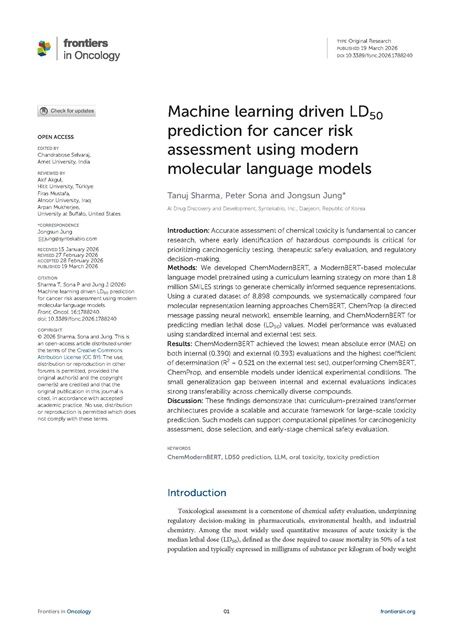
[Song Young Doo, Edaily Reporter] AI drug discovery company Syntekabio announced on March 23 that its research paper on predicting oral toxicity of chemical substances using an artificial intelligence(AI)-based molecular language model has been published in the international SCI journal Frontiers in Oncology, based in Switzerland.
The study was jointly conducted by CEO Jong-sun Chung, Tanuj Sharma, and Peter Sona. Its key contribution lies in demonstrating the potential of using AI-based molecular language models to predict chemical toxicity in advance and apply these predictions to carcinogenic risk assessment. The approach is particularly notable for addressing the limitations of conventional toxicity evaluation methods, which rely heavily on experimental procedures and require significant time and cost.
The research team developed a pre-trained AI model, “ChemModernBERT,” using more than 1.8 million chemical structure datasets, and built a model capable of predicting oral toxicity across a wide range of compounds. Leveraging large-scale chemical data, the model is able to learn complex molecular structures, offering differentiated competitiveness compared to existing approaches.
In performance evaluations, ChemModernBERT outperformed existing toxicity prediction models—including ChemBERT, ChemProp, and ensemble models—under the same external test conditions. The model recorded a mean absolute error(MAE) of 0.390 in internal testing and 0.393 in external testing, while achieving a correlation coefficient(R) of 0.72 with experimental values, demonstrating stable predictive performance across chemically diverse substances.
The study also suggests potential integration with physiologically based pharmacokinetic(PBPK) modeling in toxicity assessment. By incorporating AI-based toxicity predictions, more precise analyses in toxicology research—including cancer risk assessment—are expected to become feasible.
CEO Jong-sun Chung stated, “This study is meaningful in that it enhances the accuracy of toxicity prediction using AI-based molecular language models and demonstrates the potential for application in carcinogenicity and chemical safety assessment. We will continue to advance AI-based toxicity prediction technologies and expand their applications across drug discovery and chemical safety evaluation.”
Copyright ⓒ 이데일리 무단 전재 및 재배포 금지


