In the heart of Jongno, Seoul, where traffic and crowds constantly intersect, stands a space layered with centuries of history. At its center is Bosingak, beneath which hangs the great bell that once regulated the rhythm of an entire capital. Widely recognized today for the New Year’s Eve bell-ringing ceremony, the Bosingak Bell represents far more than a symbolic countdown. It embodies the administrative system of the Joseon dynasty, the interplay between religion and state authority, and the evolving reinterpretation of tradition in modern Korea.
The origins of the bell date back to 1468, the 14th year of King Sejo’s reign. It was originally cast for Wongaksa Temple, a royal-sponsored Buddhist site that once stood where Tapgol Park is located today. At the time, early Joseon maintained a complex relationship between royal authority and Buddhism. The bell, therefore, was not merely a temple instrument but a fusion of political authority and religious symbolism.
Over time, the function of the bell underwent a significant transformation. After the disappearance of Wongaksa, the bell was relocated multiple times before being installed in Jongno in 1619 during King Gwanghaegun’s reign. From that point, it became a public device signaling time across Hanyang. What was once a religious sound expanded into a civic mechanism that structured the daily life of the capital.
During the Joseon era, the bell rang twice daily. The dawn signal, “Paru,” announced the opening of the city gates, while the evening signal, “Injeong,” marked their closing. The bell was struck 33 times at dawn and 28 times at night, following strict regulations. These sounds functioned as both a temporal marker and an organizing principle for urban life.
Through this role, the Bosingak Bell evolved beyond ritual use into a core instrument of urban governance. Its sound synchronized the movement of government offices, markets, gates, and streets, binding the city into a unified rhythm. It was, in essence, the public signal that orchestrated the life of the capital.
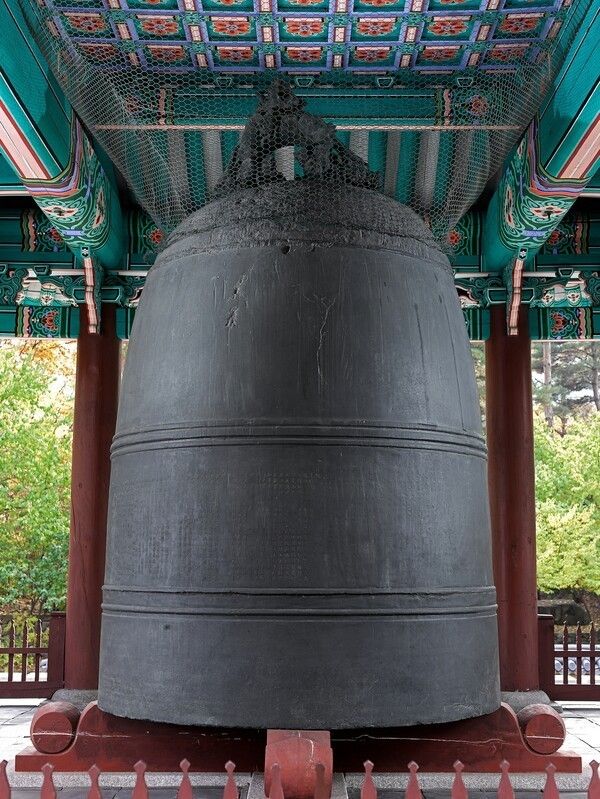
The bell’s physical form also reflects early Joseon metal craftsmanship. At the top, a loop shaped like two intertwined dragon heads supports its structure, while the body is encircled by three prominent bands. These features inherit stylistic elements from late Goryeo bells, showcasing both technical mastery and aesthetic sensibility.
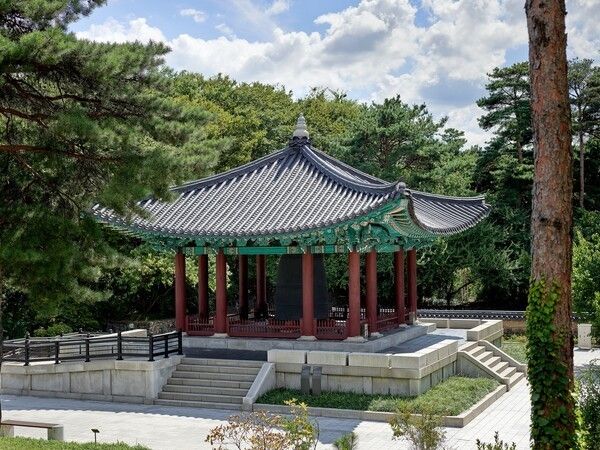
The pavilion that houses the bell also carries a long history. Its predecessor, the Jongnu pavilion, was first built in 1396 during King Taejo’s reign. Though repeatedly destroyed by fire and war, including severe damage during the Imjin War, it was continually rebuilt, maintaining its function as a central urban structure.
This area eventually became the symbolic heart of Hanyang. The name “Jongno” itself originates from the phrase “the street of the bell.” Each strike of the bell marked the beginning or end of the day, effectively setting the rhythm of the entire city.
In 1895, the pavilion was officially named “Bosingak,” with a plaque written by King Gojong. This marked its status as a defining architectural symbol of late Joseon Seoul, a period when traditional and modern concepts of time coexisted. The bell thus stands as a symbolic artifact of a transitional era.
The Korean War brought further changes. The pavilion suffered significant damage and underwent reconstruction, first in 1953 and later in 1979, when it was rebuilt as a two-story reinforced concrete structure. While preserving traditional aesthetics, the new design reflects postwar recovery and modernization.
Efforts to preserve cultural heritage led to another transformation. To protect the original Joseon-era bell, a new bell was cast in 1985. The bell used in ceremonies today is this modern replica, while the original is preserved as a historical artifact.
Today, the Bosingak Bell continues to resonate with the public every December 31 at midnight. Crowds gather in Jongno to welcome the New Year as the bell rings 33 times, marking a new beginning. This scene has become one of Seoul’s most iconic year-end traditions.
Although the city gates have long disappeared and urban life has dramatically changed, Bosingak remains a symbolic landmark in central Seoul. The bell and its pavilion represent the continuity of the city’s history and cultural identity.
No longer an administrative tool, the bell’s enduring resonance speaks to how Seoul has understood and remembered time. From a royal signal to a modern cultural heritage, the history of the Bosingak Bell reveals how a city preserves its memory through tradition.
Reported by News Culture M.J._mj94070777@nc.press
Copyright ⓒ 뉴스컬처 무단 전재 및 재배포 금지


