A court painting believed to date to the reign of King Sunjo (1801–1834), “Donggwoldo” (Eastern Palaces Painting), is set to lead visitors into a reconstructed landscape of Joseon history this spring.
The work portrays Changdeokgung and Changgyeonggung, the two royal palaces situated east of Gyeongbokgung. Two extant versions survive today, though the artist and original intent remain unconfirmed. Many scholars, however, link the project to Crown Prince Hyomyeong, the eldest son of King Sunjo.
◇ A precise cartographic painting of late Joseon palaces
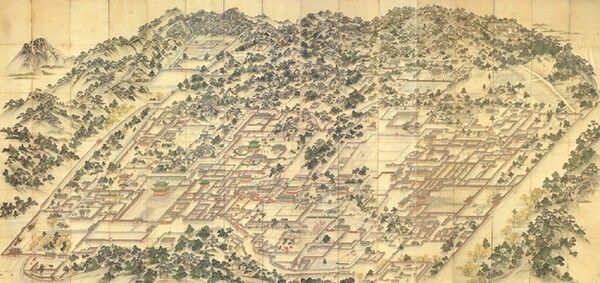
Rendered in a bird’s-eye perspective, “Donggwoldo” offers a highly detailed visualization of palace architecture and landscape. The two versions, preserved at the Korea University Museum (album format) and the Dong-A University Museum (folding screen format), are both designated National Treasures.
The Korea University version, measuring 576 cm by 273 cm, captures architectural structures, walls, and landscaped elements such as lotus ponds and ornamental rocks with striking precision. Its stylistic hybridity is notable: traditional Southern School brush techniques shape the mountains, while Western perspective informs the spatial arrangement of buildings.
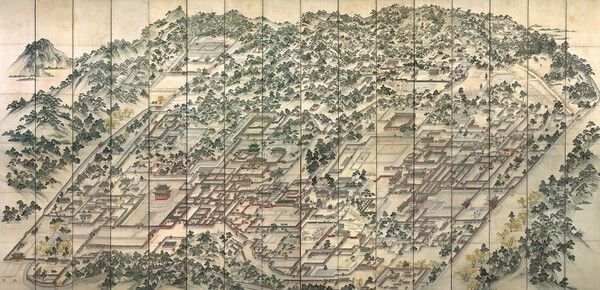
The painting is dated to between 1828 and 1830, inferred from architectural conditions depicted within. Gyeongbokjeon Hall, destroyed in 1824, appears only as a foundation, whereas Hwangyeongjeon Hall, lost in 1830, is shown intact.
Scholars suggest Crown Prince Hyomyeong, who governed as regent at the time, likely led the project. The enlarged depiction of Gyujanggak, emblematic of King Jeongjo’s reform agenda, and the accurate rendering of Yeonyeonghap, the prince’s residence, support this view. As such, “Donggwoldo” can be read not only as a documentary painting but as a visual blueprint of reformist ambition.
◇ Reinterpreting reform through space and experience
The Changgyeonggung Office under the Korea Heritage Service will run a special interpretive program, “Time of Changgyeonggung in Donggwoldo,” from March 25 to April 24, every Wednesday and Friday at 10 a.m.
Participants will tour key sites including Myeongjeongjeon Hall, Munjeongjeon Hall, and the Chundangji area with professional guides, comparing the present landscape with its depiction from over two centuries ago.
The program will also feature three expert lectures in architectural and art history, offering a layered understanding of the painting’s artistic, spatial, and historical value.
Reported by News Culture M.J._mj94070777@nc.press
Copyright ⓒ 뉴스컬처 무단 전재 및 재배포 금지


