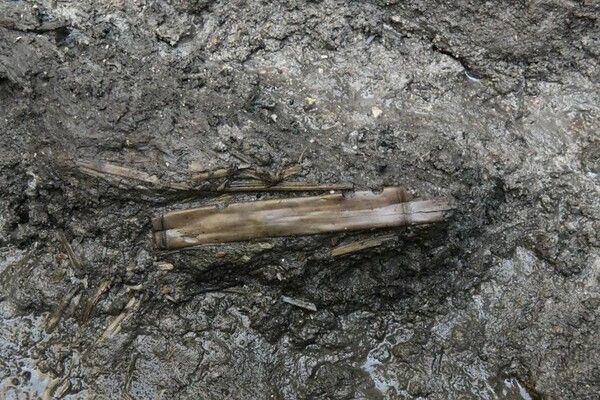
A physical example of a wind instrument from the Three Kingdoms period has been identified for the first time at a Baekje royal palace site from the Sabi period.
On February 5, the Buyeo National Research Institute of Cultural Heritage under the National Research Institute of Cultural Heritage announced that a single hoengjeok, a transverse bamboo flute dating to the 7th century Baekje period, was confirmed during the 16th excavation at the Gwanbuk-ri site in Buyeo. Until now, wind instruments from the Three Kingdoms period had been known only through historical texts and decorative representations, making this discovery the first and only confirmed physical example to date.
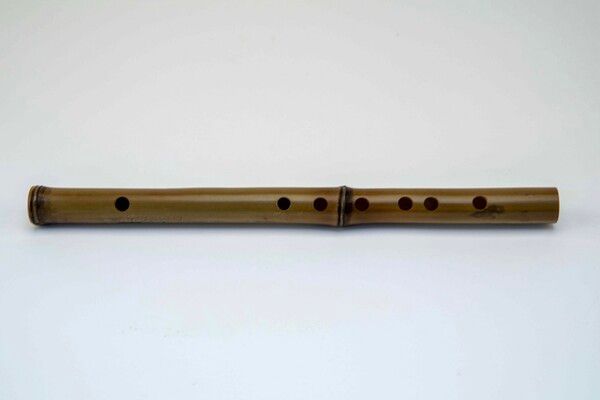
The hoengjeok was excavated from a rectangular pit near a 7th-century building site believed to have been part of the royal audience hall complex of Baekje. Made of bamboo, the instrument features four finger holes aligned in a straight row, with a remaining length of 22.4 centimeters. X-ray analysis revealed that one end of the instrument was sealed, confirming that it was not a vertically blown wind instrument but rather a transverse flute played horizontally.
Organic material analysis of the excavation area also detected human parasite eggs, suggesting that the pit may have functioned as a toilet facility attached to the audience hall. The discovery of a musical instrument in close proximity to the audience hall, where the king and officials conducted state affairs, is regarded as direct evidence that musical activities took place within the Baekje royal palace during the Sabi period.
Comparative studies with ancient wind instruments from China and Japan indicate that the hoengjeok closely resembles the modern Korean transverse flute known as the sogeum. It is clearly distinct from the vertically blown wind instruments depicted on the Baekje Gilt-bronze Incense Burner excavated from Neungsan-ri in Buyeo, offering a decisive clue for reconstructing the actual performance practices and acoustic culture of Baekje court music.
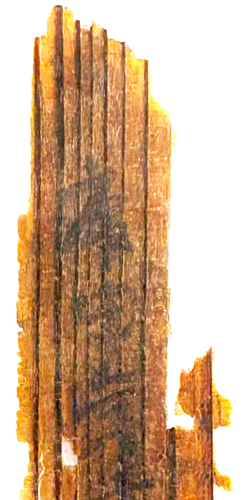
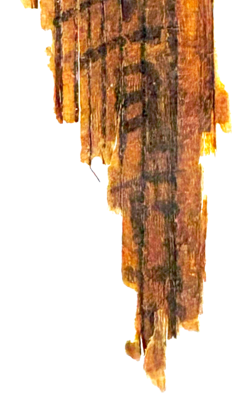
In addition to the instrument, a total of 329 wooden tablets recording administrative documents from shortly after Baekje’s relocation of its capital to Sabi were also excavated at the Gwanbuk-ri site. Based on cyclical year inscriptions, the tablets have been dated to 540 and 543, placing them in the immediate aftermath of the capital transfer in 538. The Buyeo National Research Institute of Cultural Heritage stated that these findings are expected to significantly advance research on Baekje music history and provide new insight into court culture during the Three Kingdoms period.
Reported by News Culture M.J._mj94070777@nc.press
Copyright ⓒ 뉴스컬처 무단 전재 및 재배포 금지


