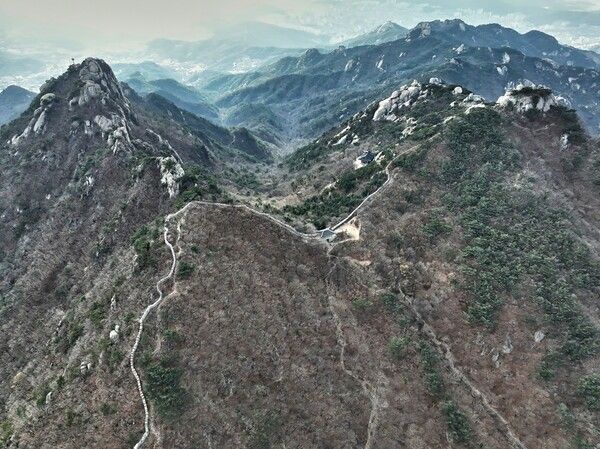
Cities are built upon memory. As buildings rise and roads expand, we often erase those memories in the name of progress. In that sense, Hanyang’s capital fortress system carries a particular weight. Encircling the heart of Joseon’s capital, this vast defensive network is more than a military relic. It is a living historical record that reveals how a capital city was protected and operated. Now, that history stands ready to be translated into a global language.
The submission of an application by the Korea Heritage Service to nominate “Hanyang’s Capital Fortress System” for inscription on the UNESCO World Heritage List carries significance beyond administrative procedure. It marks the first step toward recognizing an entire system that shows how a capital defended itself and maintained order in times of crisis as a shared heritage of humanity. The focus is not on preserving isolated sections of walls, but on evaluating the concept of a “capital defense system” as a whole.
Hanyang’s capital fortress system cannot be explained as a single fortress. Hanyangdoseong protected the administrative and royal core of the capital, Bukhansanseong served as the final military stronghold in times of emergency, and Tangchundaeseong functioned as a connecting defensive line designed to safeguard population and supplies during prolonged warfare. Each fortress served a distinct purpose, yet all were designed to operate organically under a unified strategy. This reflects Joseon’s governing philosophy, which viewed fortifications not merely as walls, but as complex infrastructure for managing the capital.
What stands out in particular is that the defense system was not limited to protecting the palace or the ruling elite. Hanyang’s capital fortress system was based on a concrete strategy that envisioned relocating the entire capital population into fortified spaces during wartime to prepare for prolonged conflict. This indicates that the state regarded all urban residents as assets and subjects of protection. Defense was not centered solely on power, but extended across the entire urban community, making the fortress system a spatial embodiment of Joseon’s governing ideology.
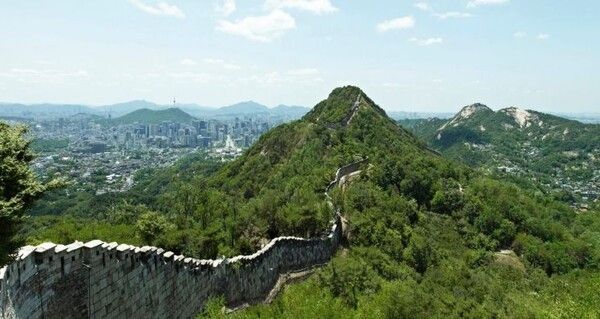
Viewed alongside other historical cities of the same era, this value becomes even clearer. While many old capitals around the world dismantled their fortifications during industrialization and urban expansion, leaving only traces behind, Hanyang’s capital fortress system remains embedded in the city’s geography and daily life. Citizens walk along fortress paths, villages formed beneath the walls, and ridgelines connect mountain fortresses to city walls, demonstrating an unbroken link between past and present. This continuity generates cultural value that goes beyond physical preservation, sustaining collective memory.
Another defining significance of Hanyang’s capital fortress system lies in its creative inheritance of East Asian fortress-building traditions. The mountain-hugging fortress structure that utilizes natural ridgelines is characteristic of East Asia’s approach to defense. In Hanyang’s case, however, this concept was expanded beyond a single mountain fortress into a multi-layered defense system encompassing the entire capital. It represents an evolution at the scale of a city, adding a new national strategy atop established tradition.
From the 18th century onward, this system became increasingly sophisticated. In an era marked by constant external threats, Joseon came to view the capital not merely as a royal residence, but as the symbolic core of national survival and the center of administration, economy, and culture. With the belief that the fall of the capital would shake the entire nation, the fortress system became both a physical defensive line and the final bulwark of the state. Hanyang’s capital fortress system is the accumulated result of this long-standing historical tension.
Culturally, the fortresses also shaped the identity of the urban landscape. The gates of Hanyangdoseong functioned as more than points of entry, regulating the rhythm of daily life, while the walls defined urban boundaries and guided movement and memory. Bukhansanseong and Tangchundaeseong blended into natural scenery in times of peace, only to transform into spaces of survival in moments of crisis. This layered meaning invites the fortress system to be understood not simply as ruins, but as a cultural landscape.
The push for World Heritage inscription is, in itself, a declaration of intent to share these complex values with the international community. Having already passed preliminary evaluation, Hanyang’s capital fortress system has demonstrated a level of universal value recognized beyond national borders. The forthcoming assessments by the International Council on Monuments and Sites (ICOMOS) will be a process of proving that this heritage stands as a historical model worthy of preservation by humanity as a whole.
Following inscription, an even more challenging task awaits in balancing preservation and use. To ensure that the fortress system does not become a frozen relic, but continues to breathe alongside the lives of citizens, careful management is required to harmonize development, tourism, and local community life. The true value of Hanyang’s capital fortress system lies not in its age, but in the fact that it remains alive within the modern city.
Ultimately, Hanyang’s capital fortress system is not merely a structure of stone, but a collective expression of how people of a past era understood their capital and sought to protect their community. Within this vast defensive network are embedded the fear of war, responsibility toward the people, and wisdom drawn from reading the land itself. The journey toward World Heritage inscription is a process of reinterpreting these meanings on the global stage, while also offering direction for how we choose to carry forward the memory of our city.
Reported by News Culture M.J._mj94070777@nc.press
Copyright ⓒ 뉴스컬처 무단 전재 및 재배포 금지


