In the early summer yard where barley ripened into a deep yellow, it was not grain but human breath that collided first. Rising above the heavy thud of flails striking the ground, “Ongheya” was not an exclamation but a communal language that sustained the rhythm of labor. This sound was etched into the body before it was written on any score, and rhythm came before meaning. Ongheya was therefore less a song than a living scene.
The etymology of Ongheya remains unknown, but that very ambiguity speaks to the essence of folk song. Not knowing who first created it or when it began reveals that this sound was not an individual composition but a collective memory. Short cries such as “onghe,” “eonghe,” and “eohwa” varied by region and situation, yet their function was the same: to gather strength, align rhythm, and raise weary bodies once more.
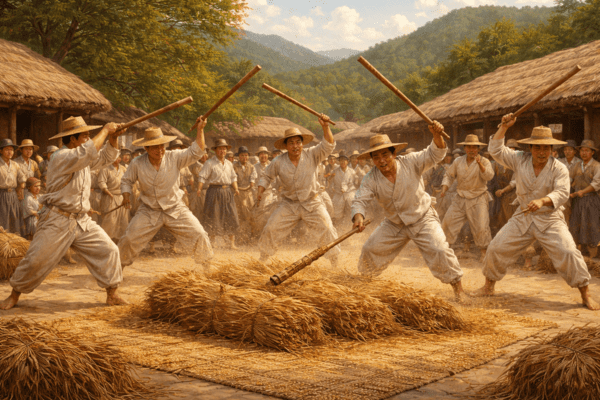
Barley threshing was labor in which speed was crucial. If the timing of the flail strikes fell out of sync, the work became slow and dangerous. Ongheya therefore allowed no leisurely melody. Its call-and-response structure, exchanged in short half-beats, directly reflected the urgency of the work. When the lead flail worker threw out the guiding call, the following workers responded immediately with “Ongheya.” Through this simple repetition, the entire yard moved like a single machine.
The lyrics were not ornate. Phrases such as “strike here” or “it goes over well” chose practicality over poetic flourish. Yet within that simplicity, tension and humor coexisted. Verses comparing well-splitting barley to frogs, or likening straw that slips neatly inside to goblins, carried wit born of endurance. Laughter was not a byproduct of labor but a technique for survival.
Ongheya was widely transmitted with Gyeongsangbuk-do at its center, but its path of movement is too long to bind it to a single regional folk song. Beyond core transmission areas such as Gyeongsan, Goryeong, Daegu, and Seongju, it spread into parts of Gangwon, Chungcheong, Gyeongnam, and Jeonnam. This distribution almost exactly overlaps with regions of barley cultivation. As grain moved, so did sound, and wherever labor practices were similar, similar sounds naturally took root.
Especially noteworthy is Ongheya’s functional transformation. Originally a barley-threshing song, it was also sung during weeding, water drawing, ground tamping, and even at post-work gatherings. Wherever labor was intense and required synchronized breath among many people, Ongheya adapted. This shows that it was not a song bound to a specific task but a rhythmic device supporting collective labor as a whole.
Musically, Ongheya is strikingly concise. With only three or four tones and an unadorned melody, it does not hinder labor efficiency. Its quick rises and falls over the skeletal tones of the menari mode bind bodies together rather than draw listeners into contemplation. As music for performance rather than appreciation, Ongheya reveals another face of Korean traditional music.
Over time, Ongheya was reborn as a popular folk song. Its fast tempo and lively lyrics moved onto stages and festive grounds. Though separated from the labor site, its energy did not disappear. Instead, its playful transformation made it more familiar to the public, becoming a bridge between tradition and the present.
In this process, Ongheya also gained status as cultural heritage. Centered on farming song transmission groups in the Daegu area, systematic preservation and transmission have taken place. This is not merely about safeguarding a single folk song but about bringing the way of life and communal sensibility of an agrarian society into the present. The designation of intangible cultural heritage is not a marker that freezes the past, but a mechanism that enables living tradition.
Historically, Ongheya is closely linked to agricultural technique. The flail-threshing method recorded in Nongsa Jikseol offers clues to the sound’s origins. In pre-mechanized agriculture, the human body, tools, and sound formed a single system. Ongheya was the lubricant of that system. When the sound stopped, the labor stopped as well.
Seen from a broader cultural perspective, Ongheya exemplifies the collective nature of Korean folk song. Rather than voicing individual emotion, it sings rules for living together. The division between lead call and response reflects not hierarchy but role sharing, mirroring the order of rural communities. No voice is complete alone; the sound is finished only through response.
Today, those who listen to Ongheya no longer hold flails. Yet the message carried by the sound remains valid. In a society that demands only speed and efficiency, Ongheya reminds us how to align our breath: how to work together, endure together, and laugh together.
Ultimately, Ongheya is not the sound of barley threshing but the sound of life itself. In the short cries laid atop sweat spilled while striking the earth, hundreds of years overlap. Simple and primal, this sound does not easily fade. Though the yards where Ongheya once echoed have vanished, its rhythm still pulses quietly in the deep layers of our culture.
Reported by News Culture M.J._mj94070777@nc.press
Copyright ⓒ 뉴스컬처 무단 전재 및 재배포 금지


