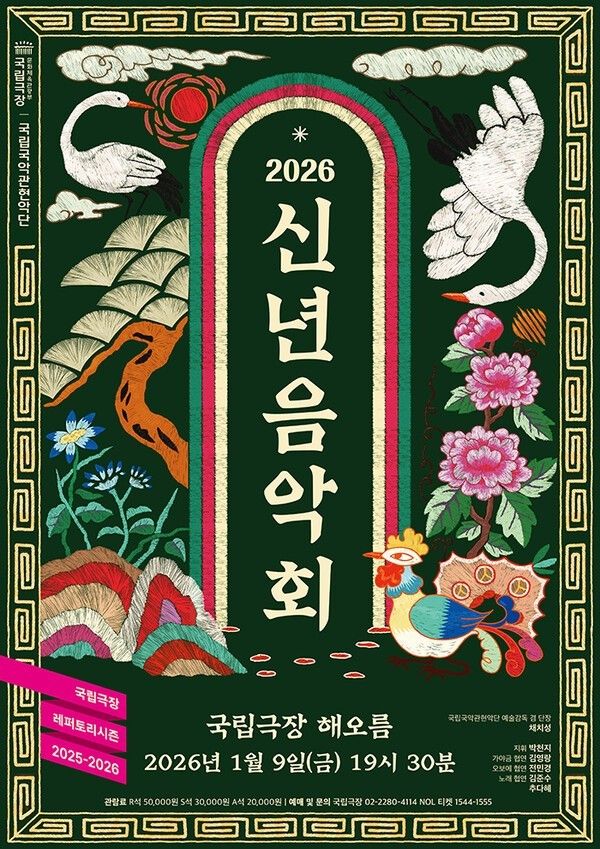
The National Gugak Orchestra of Korea will usher in the new year with its 2026 New Year Concert, bringing together leading figures of Korean traditional music. The concert will be held on January 9 at the Haeoreum Grand Theater of the National Theater of Korea, under the direction of conductor Park Cheon-ji, delivering a message of harmony and hope for the year ahead.
The program opens with a newly commissioned work commemorating the 100th anniversary of the release of the film Arirang (1926). Titled “Arirang, Three Breaths” and composed by Hong Min-woong, the piece weaves together the distinct emotional characters of Gyeonggi, Miryang, and Jindo regions into a contemporary musical narrative, highlighting the enduring vitality of Korean cultural identity across generations and regions.
The concert also features a rich lineup of solo performances. Gayageum prodigy Kim Young-rang will perform a concerto arrangement of Seong Geum-yeon–style Gayageum Sanjo (arranged by Park Wi-cheol), presenting a bright and energetic interpretation that reflects the spirit of a new generation. Oboist Jeon Min-kyung will offer a reinterpretation of the Jangsaenap (a modernized taepyungso, or improved shawm) concerto “Spring” through the oboe in “Spring of Unification” (composed and arranged by Kim Dae-seong), conveying a message of peace through deep and resonant tones.
The second half of the concert begins with “Knock” by composer Kim Baek-chan, a work that explores the free-form possibilities of Korean traditional music. Celebrated pansori singer Kim Jun-su follows with a dynamic performance of “Eosa Chuldo,” an episode from Chunhyangga. Singer Choo Da-hye, widely known for her contribution to the soundtrack of the drama When Life Gives You Tangerines, will perform “Cheongchunga,” a song that has resonated strongly with audiences.
Kim Jun-su and Choo Da-hye will then appear together for a duet of “Kwaejina Chingchingnane,” further enhancing the festive New Year atmosphere.
The concert concludes with “Gagige,” a concerto for orchestra composed by Park Beom-hun. Inspired by melodic patterns of the haegeum, the piece invites spontaneous exchanges of rhythmic calls between performers and audience, creating an energetic finale in which the stage and auditorium come together as one.
Reported by News Culture M.J._mj94070777@nc.press
Copyright ⓒ 뉴스컬처 무단 전재 및 재배포 금지


