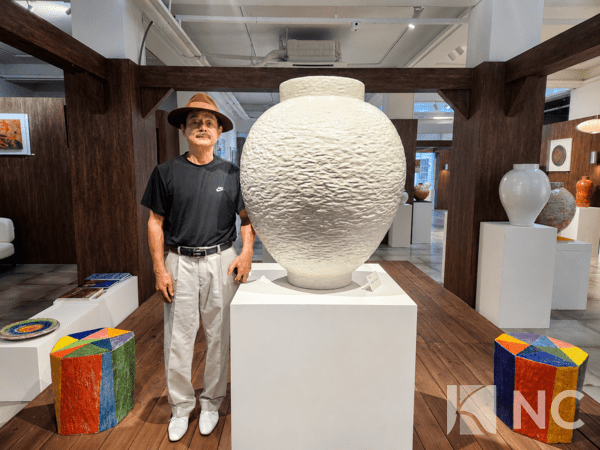
[News Culture] “A craftsman may see breaking from a prescribed form as failure. For an artist, being trapped by that form is the failure.”
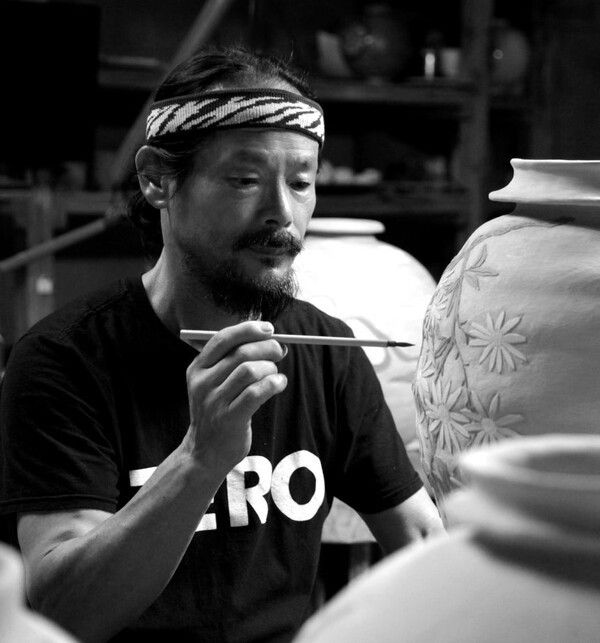
That distinction has guided Korean ceramic artist Lee Jong-neung, 68, through four decades of working with clay.
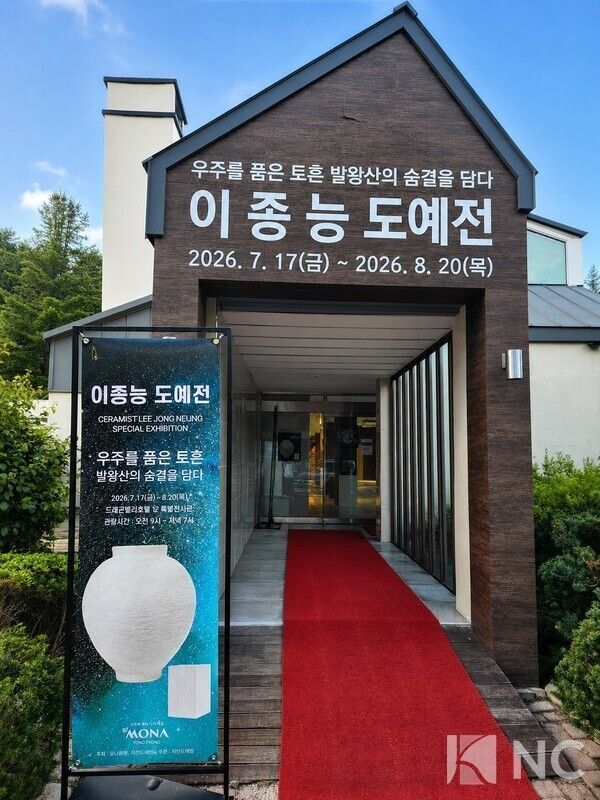
His philosophy now fills a special exhibition space at Mona Yongpyong in Pyeongchang, Gangwon Province, where competitors from more than 50 countries stayed during the 14th Haidong Gumdo World Championships, which concluded July 26.
For many of the visiting martial artists, the exhibition offered another side of Korean culture—one far removed from the force and movement of the sword, yet rooted in the same sense of discipline, tradition and form.
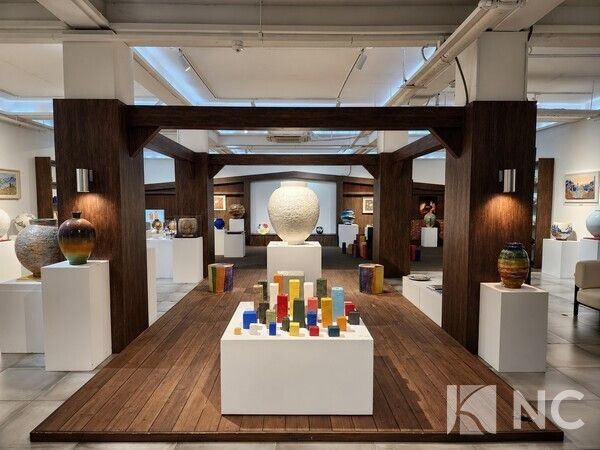
Running through Aug. 20, the exhibition brings together more than 70 works shaped in wood-burning kilns reaching temperatures of around 1,300 degrees Celsius. Monumental moon jars, ceramic murals and vividly colored sculptural pieces fill the space beneath Balwangsan Mountain, which rises 1,458 meters above sea level.
Together, they trace Lee’s fascination with earth, fire, chance and, increasingly, the cosmos.
A Moon Jar That Nearly Defied the Kiln
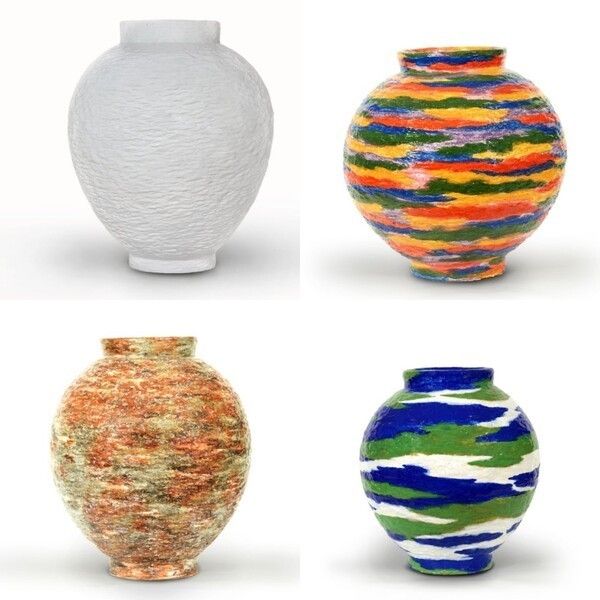
The exhibition’s most commanding work is a massive white Toheun moon jar standing about one meter tall and weighing more than 100 kilograms.
Lee spent three years bringing the piece to completion, enduring repeated failures while changing clay bodies and refining his firing technique.
The difficulty came from both its size and structure.
Large traditional storage jars can be made on a grand scale because their bases are broad and they are generally fired at temperatures of around 1,200 degrees Celsius. Lee’s moon jar, however, had to survive roughly 1,270 degrees while resting on a comparatively narrow external foot.
“Making a large onggi is like lifting weights in weightlifting shoes,” Lee said. “Firing a moon jar this large on an outer foot is closer to trying to lift 100 kilograms in high heels.”
At such temperatures, a vessel of conventional proportions can simply collapse under its own weight.
The finished jar is therefore as much a technical feat as an aesthetic one. Its imposing scale is balanced by the restrained asymmetry and open visual space long associated with the Korean moon jar tradition.
From Balwangsan to a City on Mars
Lee is known for developing what he calls Toheun (土痕), or “traces of earth.”
Rather than pursuing the mechanical perfection of the potter’s wheel, he allows irregular surfaces, fissures and the raw texture of clay to remain visible. Fire is not merely a production tool in his work. It is a collaborator, leaving behind marks that cannot be completely predicted or controlled.
That approach has recently expanded into a more speculative realm.
One work, “Neom City on Mars,” imagines how humans might live beyond Earth.
“It began with the question of what kind of homes people might inhabit if humanity eventually moves into space,” Lee said. “I began thinking about colors, textures and forms that could connect the environment of space with human emotion.”
The openings across the work’s surface can be read as docking stations for spacecraft, he explained, or as reservoirs for storing water in a future Martian settlement.
Its rough cavities and fractured textures recall planetary craters while remaining unmistakably tied to the tactile language that has become Lee’s signature.
Nearby, ceramic murals inspired by Balwangsan extend that language into two dimensions. Developed through roughly two and a half years of experimentation, the works use the natural colors and textures of clay itself, pushing ceramics beyond the vessel and toward the visual territory of painting.
One Artist, Many Worlds
Lee’s career has never fit comfortably within a single visual vocabulary.
He was selected as a representative Korean artist for the 2002 Busan Asian Games and later drew international attention through exhibitions including a 2007 presentation at the British Museum.
That range is deliberate.
Lee compares devotion to a single technique with cultivating a prized bonsai tree. His own choice, he says, has been to build an entire forest and garden.
That approach surprised visitors during his first New York exhibition in 1994.
Lee recalled that a curator from the Museum of Modern Art initially assumed the show involved several artists because of the range of styles on display.
“When I said it was a solo exhibition, the curator was stunned and asked whether I was Japanese or Chinese,” Lee recalled.
For Lee, the encounter reflected how unusual it appeared at the time for one Korean ceramic artist to work across such dramatically different scales, forms and visual languages.
His use of color follows the same elemental logic.
Ceramic murals in the Pyeongchang exhibition, along with works shown at Seoul Arts Center in 2001 when he was selected by the Matisse Foundation as an homage artist, were created without relying on conventional artificial pigments.
Instead, Lee layered natural earth from Jirisan Mountain and allowed the kiln to transform its mineral content into color.
“An Artist Fails the Moment He Becomes Bound by Rules”
Lee, whose work has also drawn praise from researchers at the Smithsonian’s National Museum of Natural History, is emphatic about defining himself as an artist rather than simply a master craftsman.
“There are many extraordinary masters and craftsmen,” he said. “But for 40 years, I have tried to remain an artist by continuously searching for something new.”
That distinction also explains his insistence on wood-fired kilns.
Rather than relying entirely on controlled firing systems, Lee allows flames, ash and temperature shifts inside kilns approaching 1,300 degrees Celsius to alter surfaces in unpredictable ways.
Those accidents become part of the finished work.
Across the exhibition, the 70-plus objects may appear radically different from one another, yet they share the same resistance to rigid control.
They belong, in Lee’s conception, to one expanding universe.
“Art does not have to begin with some grand idea,” he said. “It can be the warm happiness that grows from simplicity, from what we lack and from what we desperately long for.”
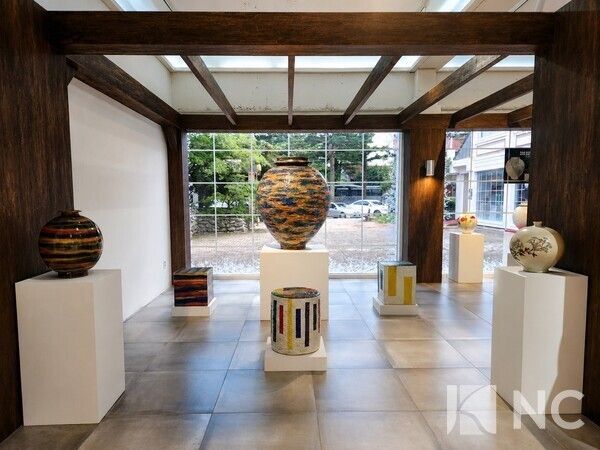
The heavy arc of a Haidong Gumdo sword and the quiet curve of a ceramic vessel met in the same space in Pyeongchang.
One is defined by movement, the other by stillness. Yet both draw strength from Korean traditions that continue to evolve rather than remain frozen in the past.
For international visitors arriving for the world martial arts gathering, the encounter broadened the idea of K-culture beyond popular entertainment. Traditional martial arts and contemporary ceramics became part of the same cultural landscape, demonstrating how heritage can be reworked into new forms and new narratives.
A Mona Yongpyong official said the exhibition was intended to bring together the natural energy of Balwangsan and Lee’s artistic achievements.
“We hope visitors find new inspiration and a sense of healing in this story of the universe shaped by earth and fire,” the official said.
Reported by News Culture M.J._mj94070777@nc.press
Copyright ⓒ 뉴스컬처 무단 전재 및 재배포 금지
본 콘텐츠는 뉴스픽 파트너스에서 공유된 콘텐츠입니다.


