The music of Czech Romantic composer Antonín Dvořák will resonate through Goyang Aram Nuri’s Aram Music Hall in a program centered on two of his most enduring orchestral masterpieces.
The Goyang Philharmonic Orchestra will present its 52nd regular concert, “MASTER PIECE from DVOŘÁK,” on June 12 at 7:30 p.m. at Goyang Aram Nuri Aram Music Hall.
The first half of the concert will feature cellist Moon Taeguk performing Dvořák’s “Cello Concerto in B minor, Op. 104,” while the second half will present the composer’s iconic “Symphony No. 9 in E minor, Op. 95 ‘From the New World.’”
Dvořák remains one of the defining figures of Romantic nationalism, weaving Bohemian folk idioms, lyrical warmth, and expansive orchestral color into works that continue to anchor the global symphonic repertoire. His music often carries both a longing for home and the emotional impressions of unfamiliar worlds, particularly during his years in the United States.
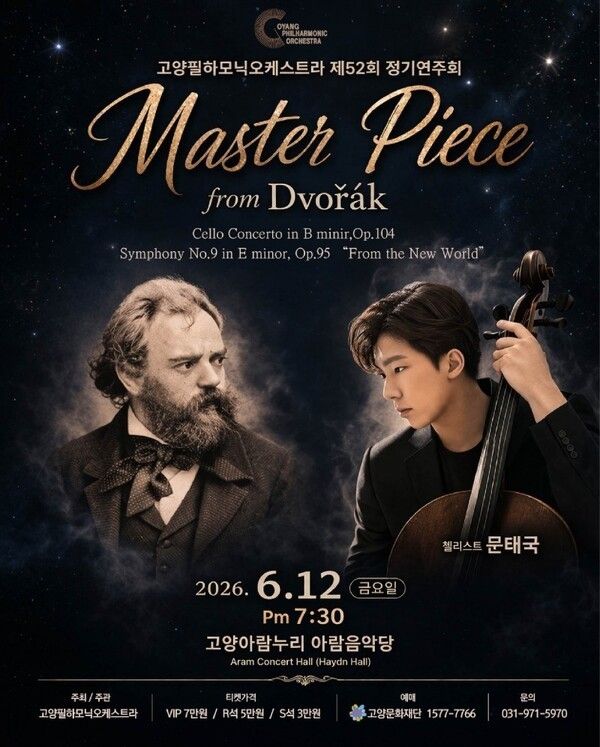
Through this program, the orchestra places Dvořák’s intimate lyricism and monumental orchestral language side by side. The cello concerto highlights the dialogue between solo instrument and orchestra through sweeping melodic lines and dramatic momentum, while “From the New World” unfolds with symphonic scale and instantly recognizable thematic power.
The concert will be led by conductor Ahn Hyun-sung, who studied under H. D. Boltz at the State University of Music Trossingen in Germany before continuing his studies at music conservatories in Opava and Brno in the Czech Republic.
Ahn has conducted ensembles including the Jeonju Symphony Orchestra, Mokpo Symphony Orchestra, Opava Municipal Orchestra, National Symphony Orchestra of Ukraine, Janáček Chamber Orchestra, Uzbekistan National Symphony Orchestra, and Ho Chi Minh City Orchestra. He currently serves as music director and principal conductor of the Goyang Philharmonic Orchestra.
Known for balancing traditional symphonic repertoire with audience-friendly programming, Ahn has worked to expand the connection between regional audiences and large-scale orchestral music. In this performance, he shapes the folk-inspired melodies, dense string textures, and brass-and-woodwind narratives that define Dvořák’s musical world.
Moon Taeguk, appearing as soloist, has established a prominent international career through major competition victories and concert appearances. He won first prize at the André Navarra International Cello Competition in 2011, first prize at the Pablo Casals International Cello Competition in 2014, and the inaugural János Starker Award. His Pablo Casals victory marked the first time an Asian musician claimed the top prize in the competition’s history.
He later served as artist-in-residence at Kumho Art Hall in 2017 and as an in-house artist at Lotte Concert Hall in 2022.
Recognized for his rich tone and restrained yet emotionally grounded interpretations, Moon has consistently explored the central works of the cello repertoire. Dvořák’s concerto, often regarded as one of the greatest cello concertos ever written, demands both technical command and sustained lyrical depth from the soloist.
Completed during Dvořák’s stay in America, the concerto opens with a forceful orchestral introduction before the cello enters with expansive, singing lines. Rather than relying on virtuosic display alone, the solo instrument carries the emotional architecture of the work through long-breathed phrasing and introspective resonance.
The second movement unfolds with Dvořák’s characteristic warmth and lyricism, as the cello builds emotional tension through its lower register while the orchestra colors the atmosphere around it. The finale alternates between dance-like vitality and reflective nostalgia before moving toward a grand conclusion tinged with quiet longing for home.
The second half’s “Symphony No. 9 ‘From the New World’” reflects Dvořák’s impressions of America while remaining deeply connected to Bohemian sensibilities. The work merges memories of home, imagined folk melodies, and the emotional scale of the symphonic tradition into one of the composer’s most celebrated scores.
Its opening movement balances tension and anticipation through dark orchestral textures and powerful thematic statements. The famous second movement begins with the English horn melody often associated with homesickness and remembrance, creating one of the most lyrical passages in the orchestral canon.
The scherzo movement carries rhythmic propulsion reminiscent of folk dance traditions, while the finale gathers the symphony’s thematic energy into a sweeping conclusion led by brass, strings, and woodwinds in dramatic exchange.
Founded in 1999, the Goyang Philharmonic Orchestra has continued to develop regional classical music culture through regular concerts, collaborative performances, and community-centered programs. The orchestra has pursued both traditional symphonic repertoire and accessible programming aimed at broadening the audience base for classical music in the Goyang region.
The orchestra stated that the performance aims to share “the deeply human emotions and timeless message contained within Dvořák’s music,” adding that audiences will experience “a night filled with profound resonance and emotional depth.”
Reported by News Culture M.J._mj94070777@nc.press
Copyright ⓒ 뉴스컬처 무단 전재 및 재배포 금지
본 콘텐츠는 뉴스픽 파트너스에서 공유된 콘텐츠입니다.


