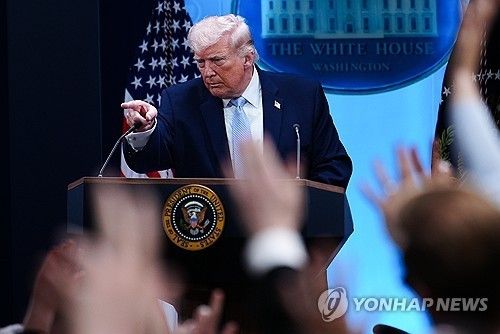
U.S. President Donald Trump has threatened to move ahead with procedures to blockade shipping through the Strait of Hormuz, reversing Washington’s earlier push for the key waterway to remain open and signaling a new phase of “maximum pressure” aimed at cutting off Iran’s war financing.
Trump’s comments on the 12th (local time), his first public message since U.S.-Iran peace talks collapsed, are widely seen in Washington as an attempt to sever Iran’s main revenue streams from crude exports and transit tolls, even at the cost of higher global oil prices and heightened military risk.
According to CNN, Iran initially shut the strait at the outset of its war with the United States, but later began allowing limited passage of oil tankers in exchange for transit fees reportedly reaching up to US$2 million per vessel. At the same time, Tehran has been exporting an average of 1.85 million barrels of crude per day during the conflict, roughly 100,000 barrels a day more than in the three months prior.
The United States, which had previously clamped down on Iranian crude sales over Tehran’s breach of the nuclear agreement, partially relaxed its oil sanctions after the war broke out, citing fears of runaway international oil prices. Officials in Washington argued that a complete halt to Iranian crude would add further upward pressure to already elevated global prices.
In a notable step last month, the Trump administration authorized the one‑month sale of Iranian oil that had been sitting offshore in tankers. The U.S. Energy Information Administration (EIA) estimates that roughly 140 million barrels reached the market through that channel, enough to cover about one and a half days of global demand.
Iran is believed to have booked sizable profits by selling those barrels at a premium to Brent, the global benchmark, while widening its customer base from a heavy reliance on China to buyers in Western markets. That diversification has helped Tehran secure war funding more smoothly, analysts say.
U.S. officials privately acknowledge that the temporary tolerance of Iranian oil flows was effectively a last‑ditch move to blunt domestic and international backlash over rising fuel costs. The administration also eased restrictions last month on several hundred million barrels of Russian crude, in a further bid to stabilize supply.
Against that backdrop, Trump’s threat to “reverse‑blockade” Hormuz is being read by some observers as a bid to regain leverage at the negotiating table after talks with Tehran stalled. By signaling that Washington, not Tehran, could now control access to the narrow chokepoint, the White House appears intent on neutralizing Iran’s long‑standing tactic of using its own blockade threats as bargaining power.
The calculation, according to diplomatic and market analysts, is that even if the move triggers short‑term volatility and price spikes, choking off Iran’s crude exports and strait toll revenues could, over time, force Tehran back to the table under less favorable terms. Some in Washington stress that the primary aim may be to maximize the “threat effect” rather than to immediately implement a full, sustained naval blockade.
Still, the risks are considerable. A real U.S. interdiction effort in the Strait of Hormuz – a narrow, congested waterway through which a significant share of the world’s seaborne oil flows – could sharply intensify instability in global energy markets and raise the economic burden on oil‑importing countries.
Military planners are also wary. The confined geography of the strait makes U.S. Navy vessels particularly vulnerable to Iranian drones, anti‑ship missiles and small‑boat swarm tactics, raising the prospect of rapid escalation from an economic pressure campaign to open confrontation.
Domestic criticism is already surfacing. Senator Mark Warner, the top Democrat on the Senate Intelligence Committee, told CNN, “I don’t understand how blockading the strait is going to pressure Iran to open the strait,” adding, “There’s no connection at all.” His remarks underscore concerns that the administration’s strategy may blur its own objectives, risking higher global costs without a clear path to de‑escalation or a revived diplomatic track.
Copyright ⓒ 뉴스로드 무단 전재 및 재배포 금지
본 콘텐츠는 뉴스픽 파트너스에서 공유된 콘텐츠입니다.


