A daily object depicting the tale of Heo Yu and So Bu, reading Goryeo thought and perceptions of power through craft
A small bronze mirror measuring just 3.7 centimeters in diameter simultaneously reveals the depth of Goryeo-period craftsmanship and intellectual history. Depicting the story known as “Heo Yu Washing His Ears,” this copper-alloy mirror from the Goryeo dynasty is regarded as an artifact that condenses the values and mental world of the era’s literati.
The mirror follows the typical form of Goryeo bronze mirrors, with its circular outer edge carved into an eight-petaled floral shape and an interior surface arranged in relief with landscape and human figures. Its refined modeling and stable composition demonstrate the high level of Goryeo metalworking, achieving a balance between decorative beauty and symbolic meaning.
The scene on the back of the mirror is drawn from the ancient Chinese tale “Gisan-Yeongsu,” dating to the era of Emperor Yao. According to the story, Heo Yu (Xu You), who lived in seclusion on Mount Qi, was offered rule over the world by Emperor Yao. Heo Yu refused and washed his ears in the waters of the Ying River, believing that merely hearing such words had defiled him. The tale is widely known as a symbolic expression of the recluse’s resolve to distance himself from power and fame in order to preserve moral purity.
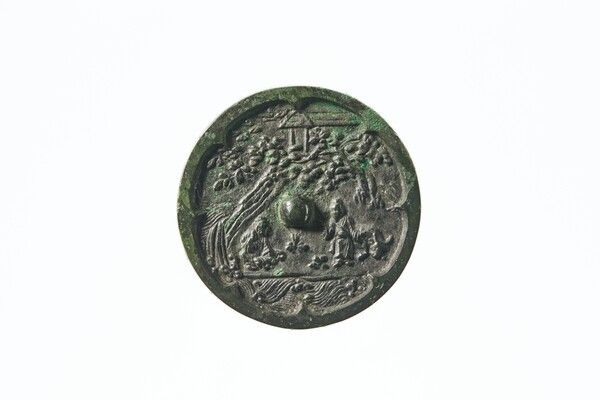
On the left side of the scene, Heo Yu is depicted seated by the water, washing his ears. Though visually calm, the act embodies an inner determination to decisively reject political authority and worldly honor. The surrounding water and forest emphasize the life of a recluse who safeguards the Way within nature.
Facing him is So Bu (Chao Fu), shown leading a colt. Upon hearing that Heo Yu had washed his ears, So Bu criticized even the act of gaining renown as a recluse as being contrary to the Way. Declaring that the water Heo Yu had washed in was unfit even for his colt to drink, So Bu ascended upstream along the Ying River. The contrast between the two figures deepens the discourse on integrity and moral steadfastness.
This juxtaposition visually reveals differences in moral standards. Although both Heo Yu and So Bu rejected power, the manner and intensity with which they distanced themselves from the secular world diverged. The Goryeo artisan effectively conveyed this subtle distinction through the flow of water and the placement of the figures.
What is particularly noteworthy is that such a narrative scene was engraved on a mirror, an everyday object. A mirror serves as a tool for reflecting one’s appearance and as a medium of self-awareness. By placing a scene symbolizing the integrity of a recluse on its reverse, the object encourages reflection not only on outward appearance but also on inner attitude.
Although Goryeo was a society that upheld Buddhism as a state religion, Confucian ethics and Daoist ideals of reclusion were also deeply embedded among the intellectual class. The tale of Gisan-Yeongsu embodied in this bronze mirror vividly reflects that ideological environment. The image of a recluse withdrawing from political power resonates with Buddhist notions of transcendence while simultaneously containing a critical view of Confucian political order.
From the perspective of craft history, this mirror is also a rare example. Most Goryeo bronze mirrors feature geometric patterns, plant motifs, or auspicious animals. Instances in which a clearly defined narrative is rendered across the entire surface are uncommon. This demonstrates that Goryeo artisans were capable of visually organizing ideas and stories beyond mere decoration.
The work also shows that Goryeo’s reception of Chinese culture was not a matter of simple imitation. While drawing upon a Chinese tale, the motif was recontextualized within an everyday object used by Goryeo people, creating a new network of meanings. Even within a dynastic state system, a cultural awareness that cautioned against power and fame was widely shared.
Though small in size, the meaning contained within this mirror is far from slight. The recluse’s attitude of washing away the language of power and preserving the Way within nature symbolizes the spiritual standards that Goryeo society held as ideals. The narrative of integrity engraved into solid bronze has preserved its significance across centuries.
This Goryeo bronze mirror depicting the story of “Heo Yu Washing His Ears” offers a multidimensional view of the thought and ethical consciousness of its time.
Reported by News Culture M.J._mj94070777@nc.press
Copyright ⓒ 뉴스컬처 무단 전재 및 재배포 금지
본 콘텐츠는 뉴스픽 파트너스에서 공유된 콘텐츠입니다.


