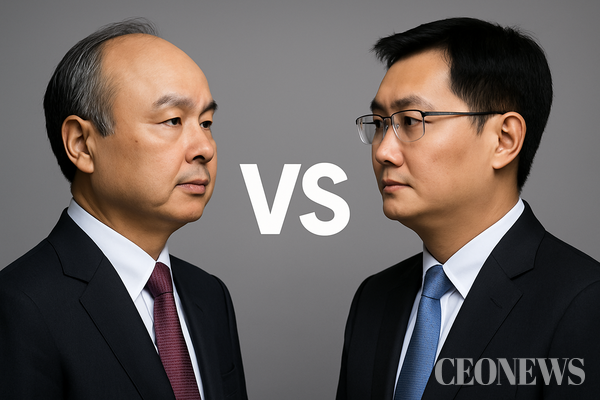
[CEONEWS = Kim So-young] What brings the future forward faster: vast pools of capital—or wallets that open every single day? Masayoshi Son (SoftBank, founder & chairman) and Ma Huateng (Tencent, founder & chairman) have rowed in opposite directions across the same tech sea. One plants the flag of capital in semiconductor design and hyperscale compute to pre-empt the next ten years; the other stitches together WeChat, games and fintech to monetize today’s ten minutes. If Episode 6 contrasted product speed with platform fabric, Episode 7 pits the architecture of capital against the economics of user time. The conclusion is simple: who lowers the cost of capital faster—and who raises perceived user value higher.
■Son’s Expansion, Ma’s Encroachment
Masayoshi Son’s playbook always begins by enlarging the board. He hunts for industry bottlenecks and binds the assets that relieve them into a single narrative: design (ARM), CPU, data centers, and AI models. When these links align, the unit cost of compute falls and the valuation of the portfolio rises like a chain reaction. Imagination moves before numbers. After hearing his pitch, investors feel the future’s puzzle is already solved. That power of persuasion attracts capital—and capital moves industries. This is how Son’s expansion is designed and executed.
Ma Huateng works differently—more precision tweezer than earthmover. A single line in a messenger chat, a few seconds of short-form video, 0.1 seconds of friction on a pay button: he knows smoothing and connecting these micro-moments creates revenue. WeChat is a messenger and a search engine; a store and a bank; a billboard and a video platform. Users have no reason to leave. One tap becomes ad income, leads to shopping, and returns as creator rewards. The secret of Ma’s growth is not a grand cannon but conversion rate: turning one person’s five minutes into five hundred million people’s five minutes.
■AI Strategy: Owner of the Infrastructure vs. Heart of the Service
At the heart of the AI transition, their lines diverge further. Son seeks ownership of compute itself. He believes power accrues to whoever secures compute that is cheap, abundant, and stable. Hence the attempt to link design assets, CPUs, and data centers into a single belt. If it works, he grips the valve of an “AI water main” on which portfolio companies depend. If it fails, volatility in capital swings straight back into earnings. Asymmetry between risk and reward—Son has always fought on that tilted board.
Ma installs AI as the heart of the service. The model is a means, not an end. As ad targeting sharpens, search grows smarter, and creation/merchant tools become easier, dwell and conversion rise naturally. For him, AI is neither a giant factory nor a glittering showroom; it is a small component embedded throughout the user journey. When those parts mesh, the platform becomes smoother—and stickier. Ma uses AI like a conjunction in daily life.
■Courage of Leverage vs. Discipline of Cash
The contrast in capital and governance is just as clear. Son willingly embraces leverage—absorbing volatility for the larger picture and pushing long, rough financing runs for mega-projects through sheer persuasion. His calendar is measured not in quarters but cycles.
Ma, by contrast, anchors trust in cash-flow discipline. He prunes non-core stakes, concentrates capital on the core, and breathes with shareholders through buybacks and dividends. The numbers slope upward steadily, and platform durability thickens year by year. The force that lowers the cost of capital is narrative for Son—and cash for Ma.
■Regulation & Survival: Persuasion vs. Optimization
They also navigate regulation differently. Son must traverse a global maze of policy, power grids, permits, and security. Pass through once, however, and explosive network effects await; massive infrastructure, once erected, is hard to topple.
Ma turns regulation into a metabolic upgrade—internalizing rules for content, games, and fintech while refining service quality. Stronger rules add cost, but they also yield a cleaner revenue mix. One is the man of persuasion; the other, the man of adaptation. Different routes, same goal: survival.
■Coordinate-Plane Positioning: Balancing Risk and Control
Place both leaders on the same axes—risk (horizontal) and control (vertical).
Masayoshi Son: high risk / mid control—designs a bigger board while accepting external volatility.
Ma Huateng: mid risk / high control—deepens the board through internal mastery.
The right question isn’t which is superior, but which fits the cycle. When interest rates and policy favor compute infrastructure, Son’s story draws louder applause. When perceived value rises in ads, commerce, and digital content, Ma’s cash machine accelerates—quietly, but decisively.
■DNA for Managers
Son-style checklist
Find the bottleneck that mint excess returns and seize it.
Bind design–manufacture–compute–service into one value-chain story.
Use narrative to lower the cost of capital, and scale to secure buying power.
Internalize permits, policy, and power as items in project management.
Ma-style checklist
Optimize the ladder from MAU → dwell → conversion → repeat.
Design cross-elasticity across ads, fintech, and content.
Treat LLMs as tools—minimize friction in creation, recommendation, and payment.
Turn cash flow into trust via buybacks and dividends.
■Where Numbers and Stories Cross
In the end, the contest is fought where numbers intersect with story. If Son lowers compute cost and secures stable supply, his portfolio earns a simultaneous re-rating. If Ma lifts dwell and conversion one notch, ads, commerce, and content push one another’s revenues upward. One governs the industry’s ten years; the other governs the user’s one minute. Ten years move slowly yet rarely reverse once changed; one minute shifts fast yet repeats daily and converts to cash. Which is stronger? It depends on the cycle’s temperature—and the company’s stamina.
■The Winner’s Equation
After 2025, markets demand convergence of the two axes. Who lays the bridge first—the one gripping the water main of compute, or the one building the fortress of daily life? When Masayoshi Son shakes the price of infrastructure and Ma Huateng accelerates life’s flow, the standards are rewritten. The reader’s choice collapses into one question: Will you buy compute—or sell time?
The world moves too fast, and capital is too shrewd, to prophesy an absolute victor. Today’s verdict is provisional: whoever learns the other’s language first and applies it in the field—at speed—wins.
Copyright ⓒ CEONEWS 무단 전재 및 재배포 금지
본 콘텐츠는 뉴스픽 파트너스에서 공유된 콘텐츠입니다.


