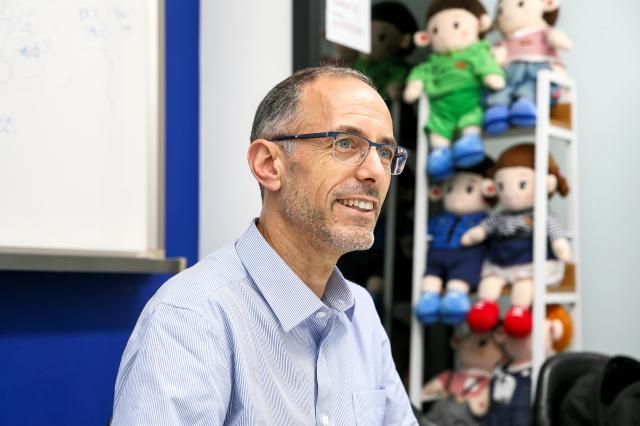
SEOUL, September 16 (AJP) - Technology often feels like the magic bullet for society’s biggest challenges, but J. Artur Serrano, a prominent researcher from Norway, insists it’s just one piece of a larger puzzle. "Technology is a tool," Serrano, a professor at the Norwegian University of Science and Technology, told AJP. "But real change starts with us—our mindsets, our policies, and our willingness to embrace responsibility."
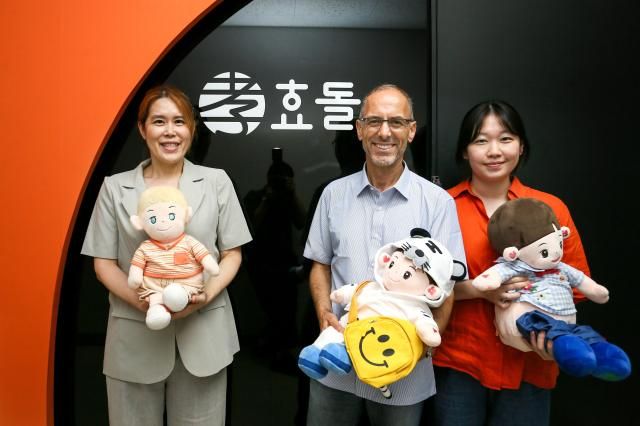
Serrano, an expert in care and assistive technologies for neurocognitive and mental health disorders, recently visited Hyodol, a Korean company specializing in care robots, in Anyang, south of Seoul. Accompanied by researchers from KAIST, he was eager to see how Hyodol’s innovative robots are making a difference in elderly care.
Hyodol’s doll-shaped robots resemble seven-year-old children, equipped with advanced AI features like ChatGPT. They engage in conversations, remind elderly users to take medications, and even alert caregivers if the users remain inactive for too long. The robots are already in use in around 10,000 homes and elderly care facilities, and their impact has been profound.
"Hyodol’s success isn’t just in its technology—it’s in the people using it," Serrano noted, expressing his admiration. "In almost five years of research into social robotics, I have not seen anything like this." He pointed out that caregivers, who facilitate the robots’ use, play a crucial role in integrating technology into daily life.
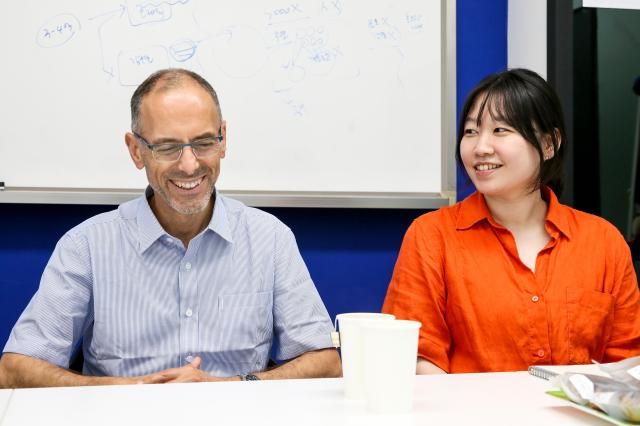
"Caregivers are mediators," said KAIST researcher Shin Hee-sun. "They help bridge the gap between the elderly and the technology, ensuring it’s not just a machine, but a companion."
According to data from Kangwon National University Hospital, Hyodol robots have significantly eased the burden on caregivers, reducing stress and improving mental well-being among elderly users. A six-week study showed that caregivers of dementia patients experienced reduced strain, and research on high-risk elderly individuals in South Jeolla Province indicated a notable decrease in depression and suicide risk rates.
But for Serrano, the story doesn’t end with technological achievements. "We’re living through a crisis," he said, reflecting on the broader challenges societies face. "It’s not just about health or economics or aging—it’s a crisis of hope. And technology alone can’t fix that."
Serrano believes that true change comes from a collective sense of responsibility. "Responsibility," he explained, "is a combination of 'respond' and 'ability.' It’s what keeps things sustainable and helps us resiliently seek effective ways to adapt to changing environments."
He stressed the importance of individuals embracing their own roles in society rather than deferring to higher authorities or external solutions. "Accept your own responsibility," Serrano urged. "Teach your friends, colleagues, and children to do the same. We must have the determination to find the best way to guarantee our quality of life."
Serrano’s message is clear: while technology can support us, the real power lies within ourselves. "We have to invest in hope," he said. "We have to believe that we are capable of change, and that by collaborating, thinking positively, and adapting, we can overcome even the toughest challenges."
By focusing on our shared responsibilities and the power of community, Serrano offers a vision of a future where technology complements human effort, but never replaces it. As societies around the world grapple with aging populations and other complex issues, his call to action is both timely and vital: "Change begins with us."
Copyright ⓒ Aju Business Daily 무단 전재 및 재배포 금지
본 콘텐츠는 뉴스픽 파트너스에서 공유된 콘텐츠입니다.
다음 내용이 궁금하다면?
광고 보고 계속 읽기
원치 않을 경우 뒤로가기를 눌러주세요


