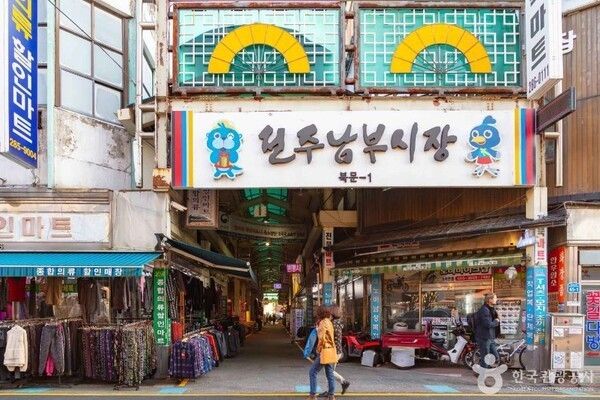
[News Culture] Before sunrise, vendors begin setting up along the Jeonjucheon stream between Ssajeon Bridge and Maegok Bridge in Jeonju, North Jeolla Province.
By around 4 a.m., tables and makeshift stalls are stocked with vegetables, fruit, agricultural produce and other ingredients. By about 10 a.m., much of the trading is over. Jeonju calls it the “dawn goblin market,” a market that appears before daybreak and largely disappears as the regular business day begins.
The scene offers a compact view of how Nambu Market has operated for generations. Long before its permanent shops open, commerce is already underway beside the stream.
The market’s roots reach back to trading grounds outside the southern gate of the old Jeonju fortress. Agricultural products from the Honam Plain mixed with handicrafts and goods brought by merchants from surrounding regions. Roads and railways later redirected those flows during the Japanese colonial period, while post-liberation redevelopment, privatization and shifts in urban transportation reshaped the market again.
By the 1980s and 1990s, changes to bus routes, the relocation of wholesale agricultural facilities and the arrival of large retailers had put further pressure on traditional commerce.
Through those changes, Nambu Market remained closely tied to food. Bean sprout soup with rice, blood sausage, home-style set meals and red-bean kalguksu became part of a working market’s daily rhythm rather than attractions designed for visitors.
A Commercial Network Outside Jeonju’s Four Gates
During the Joseon period, Jeonju was both the administrative seat of Jeolla Province and a major commercial center.
Its location between the Honam Plain and inland mountain regions, together with access to the Jeonjucheon and Mangyeong River systems, made it well positioned for the movement of agricultural products, handicrafts and everyday commodities. It was also an important overland junction between the capital and southern Jeolla.
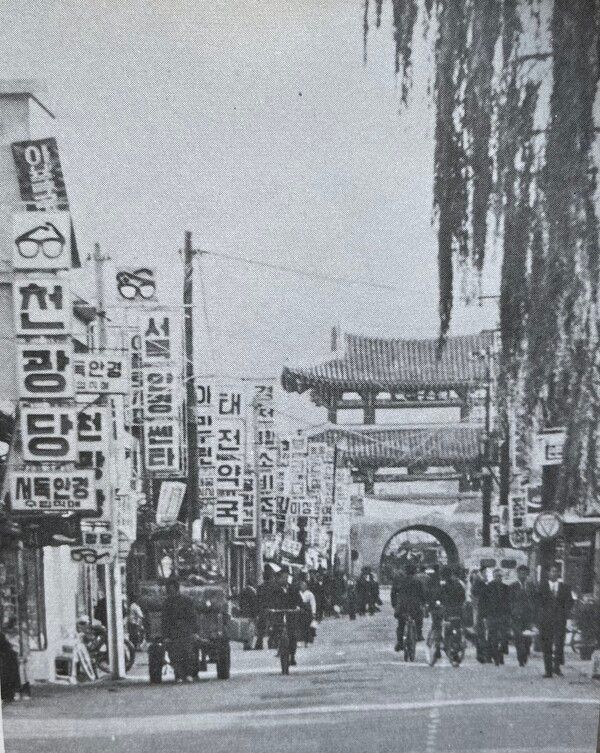
Records from the 18th century describe markets operating around the four gates of Jeonju fortress. The larger markets outside the south and west gates were grouped as major markets, while those near the north and east gates were smaller operations.
Inside the southern market was a ssajeon, or rice market. Tobacco and long smoking pipes were traded near Maegok Bridge. A cattle market developed along the Jeonjucheon, while the western market became known for salt and the northern market for textiles.
Rather than functioning as isolated bazaars, the markets formed a network divided by merchandise and trading days.
The market outside the southern gate benefited particularly from the heavy movement of people and goods through Pungnammun. According to historical records compiled in the Encyclopedia of Korean Culture, the markets around Jeonju’s four gates declined during the colonial era, and the southern and western markets entered a merger process in 1923.
Goods sold at Jeonju’s markets in the late Joseon period included rice, ginger, paper, fans, lacquerware, ceramics, bamboo products, persimmons, pomegranates, ramie, tobacco and seafood. Produce from the surrounding plains, commodities from mountain regions and marine products arriving from the west coast converged in the city.
That combination of abundant supply and demand from a major administrative center helped make Jeonju one of the region’s principal marketplaces.
Roads and Railways Rewrite the Market Map
Modern transportation networks disrupted that position.
As roads between Jeonju and Gunsan improved during the Japanese colonial period and rail transport became more important, agricultural distribution routes changed rapidly. Japanese landowners and agricultural companies increasingly moved rice from the plains toward Gunsan and Okgu rather than through Jeonju’s traditional markets.
For a period, Jeonju lost some of its importance as a commercial hub, with its market turnover reportedly falling behind centers such as Namwon and Gimje.
The physical structure of the market also changed. A public market serving primarily Japanese customers was incorporated into the southern market in 1928, followed by the establishment of a separate fish and vegetable market in 1929.
Records from 1924 describe the Jeonju market as occupying roughly 5,725 pyeong, or about 18,900 square meters, with 10 permanent shop buildings, one fish-and-vegetable building and approximately 1,200 retail merchants.
After Jeonju was elevated from a township to a city in 1936, eight new market buildings containing 36 units were constructed. Additional permanent shops and fish-and-produce facilities followed in 1937. The name “Nambu Market” is believed to have come into wider use around this period.
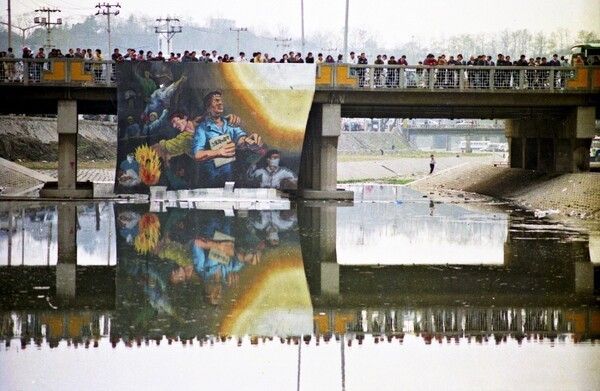
Attempts to clear temporary stalls after embankment construction along the Jeonjucheon did not eliminate street commerce. Vendors simply reappeared on the embankment and around the edges of the formal market.
The coexistence of registered shops and informal stalls would become one of Nambu Market’s defining characteristics.
A Modern Market Building — and the Vendors Left Outside
After liberation and the Korean War, the market remained an important source of food and household goods for Jeonju residents.
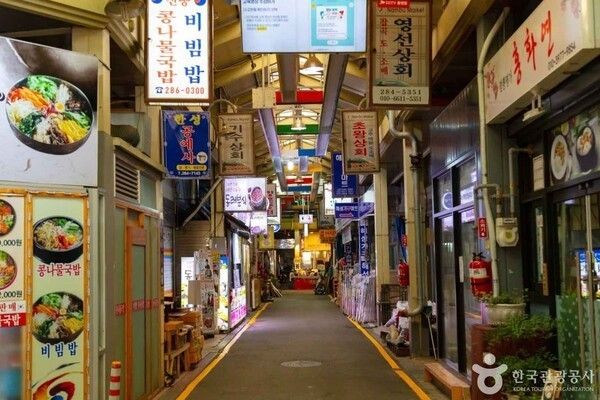
Construction began in November 1968 on a modern commercial building that opened the following February. Covering about 870 pyeong, or roughly 2,876 square meters, with 141 shops, it established much of the market’s present-day physical framework.
But the new building was too small to accommodate everyone seeking space inside.
Street vendors again filled the surrounding area.
Jeonju later moved to privatize the commercial complex. Complicated ownership arrangements involving both buildings and land made individual sales difficult, so the city instead pursued a collective sale through a merchants’ organization.
The Nambu Market Prosperity Association was established in 1976, and privatization was completed in 1978. The organization’s close connection to the property transfer process gave Nambu Market an institutional history that differed from many other traditional markets.
Street vendors also remained part of that history. Around 300 vendors faced removal from the market area in 1971, but many continued trading after relocating nearby. Booths were installed during riverside improvements in 1988, and a tented second-floor section later developed into what became known as Saemaeul Market.
Permanent shops, street stalls and these additional commercial spaces gradually formed a single market ecosystem.
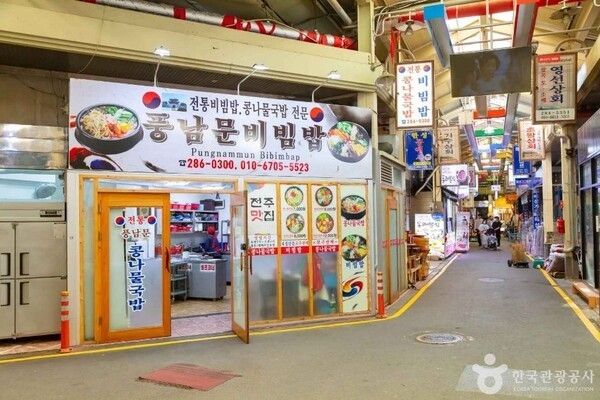
A Working Meal: Bean Sprout Gukbap and Pisundae
Few foods reflect Nambu Market’s working history more directly than kongnamul gukbap, Jeonju’s bean sprout soup with rice.
One widely cited account traces the dish to traders and ordinary marketgoers who brought rice with them and ate it with hot broth at the market.
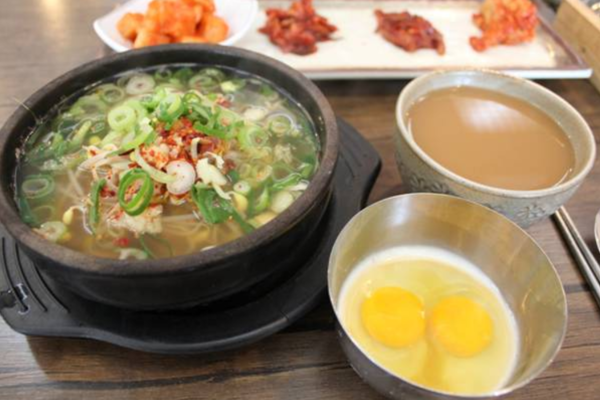
The Nambu Market style is distinguished by toryeom, a technique in which cooked rice and bean sprouts are placed in an earthenware bowl and repeatedly warmed by pouring hot anchovy-and-kelp broth over them and draining it away. The dish is heated through without being brought to a rolling boil in the bowl.
A soft egg served separately, roasted seaweed and a small serving of moju, a lightly alcoholic spiced drink, traditionally accompany the meal.
The practice of eating seaweed with the soup has also been linked to market culture: shoppers who had purchased dried seaweed would sometimes share it with others while eating at local soup shops.
For merchants, porters and customers with little time to spare, kongnamul gukbap offered something practical — a hot, filling meal that could be served quickly.
Pisundae, a type of Korean blood sausage, occupies a similar place in the market’s food culture.
Unlike versions dominated by glass noodles, pisundae is densely filled with blood, vegetables and meat inside pork intestine. In Jeonju, it is commonly served with chives and a vinegar-based red chili sauce. In soup form, generous portions of meat, broth and rice made it particularly suited to physically demanding work.
Red-bean kalguksu and inexpensive baekban meals also flourished in a market where ingredients were readily available.
Together, these dishes helped turn Nambu Market into what was effectively one of Jeonju’s largest communal kitchens.
One Market, Three Different Clocks
The riverside dawn market still operates today between Ssajeon Bridge and Maegok Bridge.
The name Ssajeon itself preserves the area’s connection to the historic rice trade. Records indicate that rice, tobacco, smoking pipes, firewood and cattle were once traded around the riverside.
The precise footprint of today’s market cannot simply be overlaid on the trading grounds of the late Joseon period, but the Jeonjucheon corridor has served as commercial space for generations.
Nambu Market entered another phase of reinvention in the 2000s.
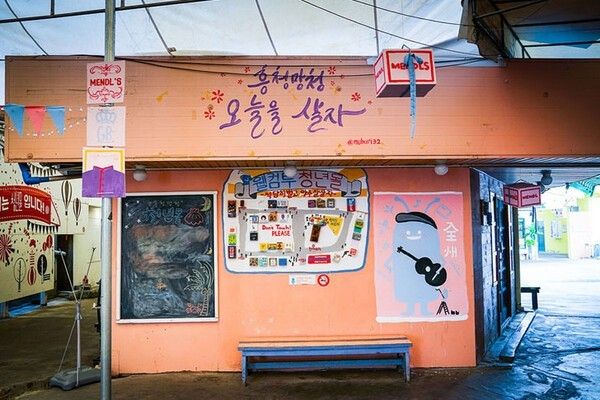
An arcade was installed in 2003, and in the early 2010s previously underused space on the second floor began attracting young merchants and artists. While long-established shops downstairs continued selling vegetables, dried seafood, textiles, furniture and medicinal ingredients, the Youth Mall brought in restaurants, cafés, workshops and bookstores.
The Hanok Village Night Market, launched in October 2013, added another layer. Mobile food stalls began operating along the market’s aisles on Friday and Saturday evenings, drawing visitors from Jeonju Hanok Village deeper into parts of the market that had previously received less foot traffic.
The result is a market that operates on three different clocks: agricultural vendors arrive before sunrise, established shops carry the daytime trade, and night-market stalls draw another group of customers after dark.
Nambu Market has also been selected this year for the Ministry of SMEs and Startups’ “Century Market” development program, making it eligible for up to 4 billion won in support. Plans are expected to include multilingual information services and improvements to digital payment infrastructure.
To visitors, a bowl of kongnamul gukbap or a plate of pisundae may register first as a Jeonju specialty.
Within Nambu Market, however, both belong to a longer history of labor.
The vendors setting up beneath Ssajeon Bridge before dawn are not reenacting an old market tradition. They are doing business. The market remains a place shaped by the immediate mechanics of buying, selling, carrying, cooking and eating.
That distinction helps explain its longevity.
Nambu Market has survived not because it remained unchanged, but because it repeatedly adjusted — from gate-side commerce to permanent shops, from riverside stalls to a youth mall, and from working meals for merchants to food that now draws travelers as well.
Its history is less a story of preservation than one of continual adaptation.
Reported by News Culture M.J._mj94070777@nc.press
Copyright ⓒ 뉴스컬처 무단 전재 및 재배포 금지


