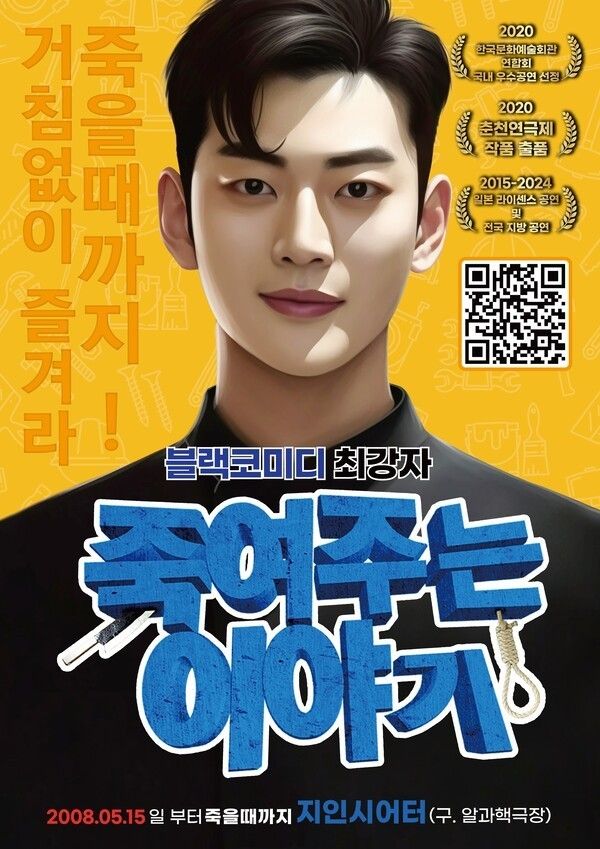
[News Culture] A Killer Story begins with people who believe they have reached the end of the line.
What follows, however, is not a straightforward tragedy. The long-running Daehangno production turns that premise into black comedy, using wordplay, unexpected encounters and audience participation to follow characters whose certainty about giving up begins to unravel once they are forced into one another’s lives.
The play has been running since its May 2008 premiere and has drawn a cumulative audience of 4.5 million, establishing itself as one of Daehangno’s enduring open-run productions.
Its longevity is striking partly because the subject remains difficult.
The characters enter the story carrying thoughts of abandoning life, but the production does not leave them in a single emotional register. Despair exists alongside hesitation, curiosity, embarrassment and the residual desire to remain connected to someone else.
That contradiction gives the comedy its shape.
The play does not suggest that pain disappears because people laugh. Instead, humor creates room for the characters to behave unpredictably, exposing the gap between what they say they want and what they continue to reach for.
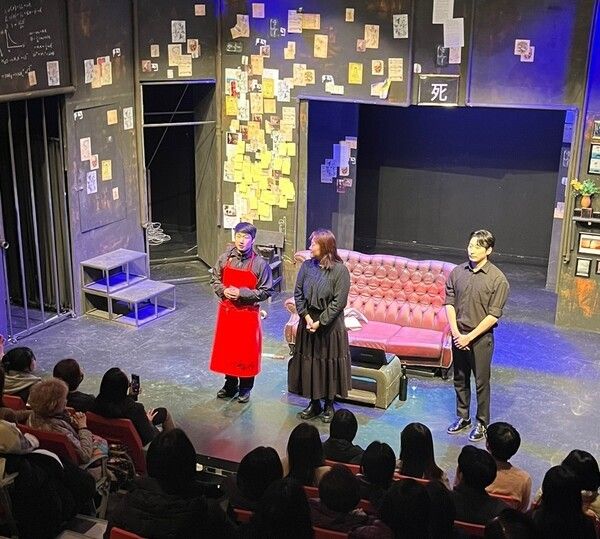
Audience participation has become one of the production’s defining elements.
Rather than following a completely sealed sequence of dialogue and action, the performers respond to reactions in the room, allowing timing and comic rhythm to shift from one performance to another.
That flexibility has helped sustain the production over nearly two decades.
A long-running comedy depends not only on preserving familiar scenes but on keeping them responsive to the people watching. Different audiences laugh at different moments, react differently to uncomfortable material and alter the pace with which performers move through the story.
The result is a production whose basic framework remains recognizable while the atmosphere can change from night to night.
That matters for a play dealing with characters at emotional extremes.
If the premise were treated only as a fixed message about despair and recovery, repetition could easily flatten it. A Killer Story instead relies on instability: one line can land as dark humor in one room and carry more discomfort in another.
The audience becomes part of that calibration.
The play’s title also points toward its tonal contradiction. Death may provide the initial setup, but the drama is sustained by people who continue talking, arguing, reacting and making choices long after they thought they had no choices left.
That is where the production’s comic energy and emotional structure meet.
The characters are not presented as symbols of resilience. They are inconsistent, impulsive and often contradictory — qualities that make their continued attachment to life feel less like a lesson and more like behavior.
After 18 years, A Killer Story continues as an open run at Jiin Theater in Seoul’s Daehangno district.
Its central situation remains dark, but the play keeps finding variation in the same unresolved question: what happens when people who think they want an ending discover that they are still responding to the world around them?
Reported by News Culture M.J._mj94070777@nc.press
Copyright ⓒ 뉴스컬처 무단 전재 및 재배포 금지


