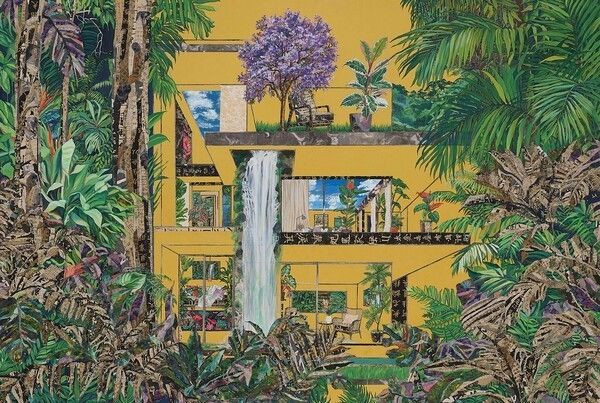
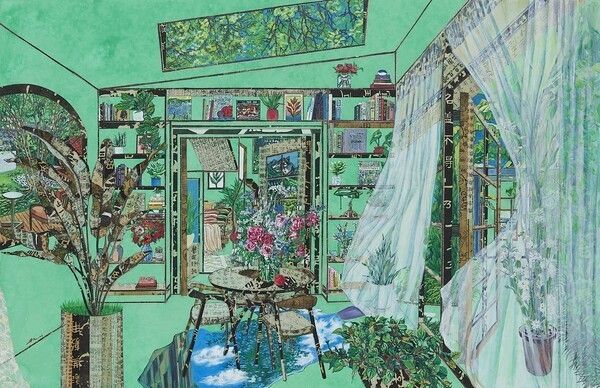
[News Culture] A waterfall cuts through the middle of a room. Vines climb window frames and walls, while leaves inside seem to merge with the vegetation beyond. Look closer and the architecture itself begins to change: walls and furniture are built from fragments of old books, their paper and printed sentences turned into material.
There are no people in sight, yet the rooms retain traces of habitation.
In-kyung Kwon’s solo exhibition “When the Forest Grows Thick in Your Room” takes the room as its central motif. Her interiors are not simply domestic settings. Windows, curtains, walls, furniture and plants regulate how much of the space can be seen, turning architecture into a way of considering privacy and the distance between people.
The forest complicates those boundaries. It enters through windows, gathers around furniture and at times seems to take over the room, although the architecture itself never entirely disappears.
Rooms With Different Degrees of Openness
Kwon’s interiors are rarely completely closed or fully exposed.
Some windows are open, others partly covered by curtains or plants. In one work, the viewer can see deep into the room; in another, only a fragment of furniture appears behind foliage.
The variations give each room a different level of access. Rather than equating intimacy with complete openness, Kwon uses these partial views to suggest that closeness can coexist with limits.
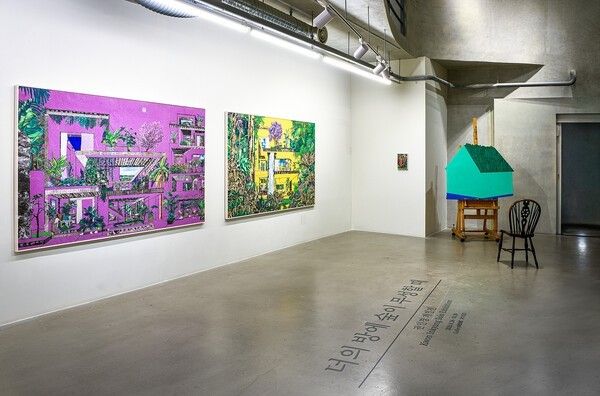
The viewer is repeatedly placed in the position of looking in without being given the whole interior. The amount of space revealed changes from one work to another, making windows and doors less like neutral architectural elements than devices that regulate visibility.
That structure connects the physical room to the exhibition’s broader interest in relationships. The distance between inside and outside remains adjustable rather than fixed.
Old Books Become Walls, Floors and Furniture
Kwon has long used fragments of old books in her work.
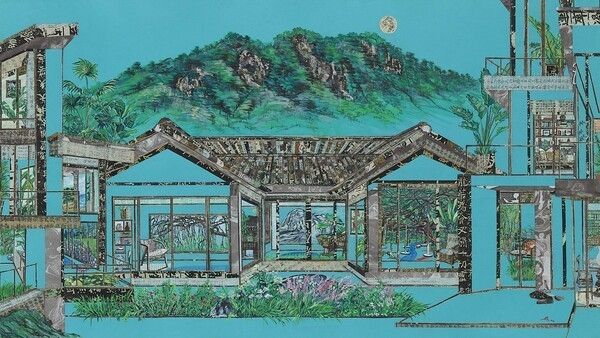
She cuts aged pages and incorporates them into walls, columns, floors and furniture. The printed paper is not simply applied as decoration; it becomes part of the architecture itself.
Once removed from the books they belonged to, individual words and sentences lose their original context. Kwon rearranges them within a new structure, placing fragments from different sources side by side.
The process parallels the way memory appears throughout her work. A past event is rarely retained in full. Particular words, places, smells or images remain, then acquire different meanings as time passes.
Kwon’s earlier work frequently addressed cities and the accumulation of memory within architecture. The old-book collage allowed different forms of time — the history carried by printed texts and the histories embedded in built spaces — to occupy the same surface.
When the Architecture Begins to Grow
The role of those fragments changes in the new exhibition.
In Kwon’s earlier “Open Room” series, pages from old books were used largely to construct interior architecture. In “When the Forest Grows Thick in Your Room,” the collage begins to extend into vegetation.
Leaves, vines and dense foliage spread through spaces once dominated by walls and furniture. Small potted plants that appeared in earlier interiors have grown considerably, sometimes making it difficult to tell whether the forest is entering the room or the room itself is expanding into the landscape.
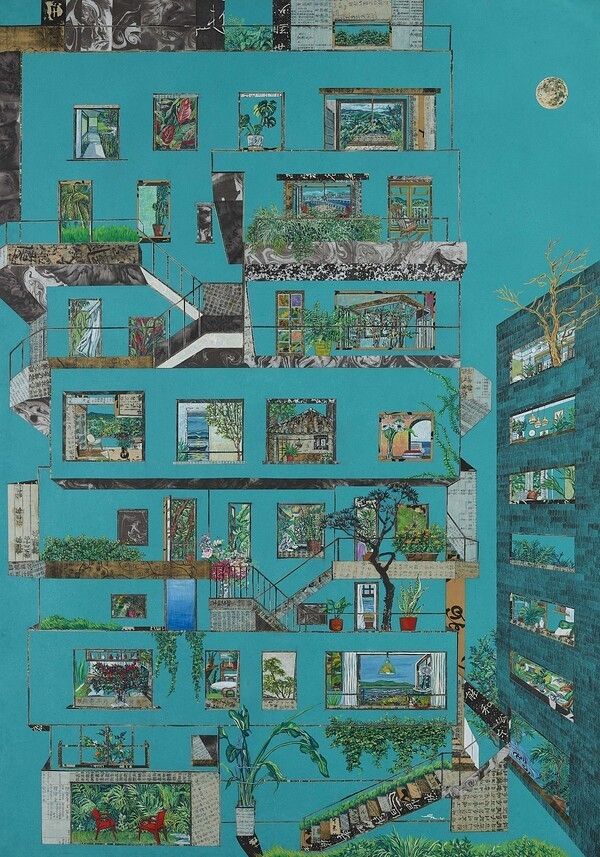
Yet the plants do not simply destroy the domestic space. Their presence varies from room to room. Some remain contained in pots, while others climb farther through windows and across interiors.
The forest therefore functions less as an image of takeover than as a changing point of contact between inside and outside.
A Waterfall as a Moving Boundary
One of the more striking additions to Kwon’s recent work is a waterfall placed inside the room.
Water falls through the interior, dividing the space while partially obscuring what lies behind it. Unlike a wall or locked door, however, water cannot establish a permanent barrier. It moves, seeps through gaps and allows intermittent glimpses of the other side.
The device extends Kwon’s use of curtains, windows and plants as ways of controlling what can and cannot be seen.
The waterfall is both barrier and opening. Parts of the room disappear behind it, while others remain faintly visible through the falling water.
That instability mirrors the way boundaries operate elsewhere in the exhibition. They are not presented as fixed lines but as conditions that can become more or less permeable depending on the space.
Several Views at Once
Kwon also abandons a single, consistent viewpoint.
One room may be viewed from above, another from below and another straight on. Perspectives that could not be seen simultaneously from a single physical position are combined within the same painting.
This approach gives the interiors a constructed quality. Rather than reproducing a room as it would appear from one point, Kwon assembles multiple ways of seeing it.
The strategy has roots in her earlier work on urban space, where different times and viewpoints were frequently layered within a single image.
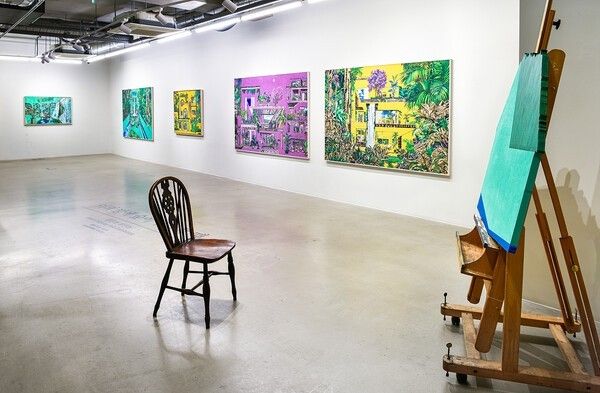
Here, the shifting viewpoints serve a more intimate subject. They offer several approaches to a private space without making that space completely knowable.
Even when the viewer is given more than one angle, parts of the room remain hidden behind plants, walls or water.
The Person Who Is Not There
Human figures are conspicuously absent from Kwon’s interiors.
In “The Moment We Faced 4,” flowers sit on a table, a door has been left open and a white duvet rises across a bed. The resident is nowhere to be seen, but the arrangement of objects suggests that someone has only recently left.
Furniture, bedding and flowers begin to carry information that might otherwise have been supplied by a figure.
The absence also leaves room for the viewer. Without a specific person occupying the space, the room can accommodate other memories or associations.
A similar process takes place in Kwon’s collage. The authors and original contexts of the old sentences recede after the pages are cut apart, allowing new relationships to form between words, images and architecture.
Between Jeong Seon’s Garden and Kwon’s Interior
Cheon Park, chief curator at Cian Art Museum, connects Kwon’s work with Jeong Seon’s Cheokjaejesi, painted around 1741.
The older work depicts a sarangbang, a traditional men’s study and reception room, surrounded by banana plants and trees. From outside, vegetation partially conceals the interior; from within, the surrounding garden remains open to view.
The comparison is less about establishing a direct lineage than about the role of greenery in defining the relationship between interior and exterior.
Kwon’s vines and Jeong Seon’s plants belong to very different pictorial worlds, but both make the boundary between room and landscape central to how the space is perceived.
From the City to the Private Room
Kwon studied Oriental Painting at Hongik University, completing bachelor’s and master’s degrees before earning a doctorate in fine arts.
Her earlier work focused extensively on urban landscapes, memory and the layers of time accumulated within a place. More recently, her attention has moved inward, from the city as a whole to the individual room.
Her 2023 solo exhibition at Gallery Meme was titled “Open Room.”
The shift in scale has not necessarily simplified the work. Within the smaller space of the room, Kwon now brings together old texts, contemporary furniture, vegetation, waterfalls and glimpses of the outside world.
The collage technique remains, but its role has changed. Fragments of old books that once helped construct urban architecture now move through domestic interiors and into the forest itself.
The exhibition ultimately returns to the question of how much openness a relationship requires.
Kwon’s rooms avoid both extremes. They are neither sealed off nor completely exposed. Windows, curtains, leaves, potted plants and falling water create several layers between the viewer and the space within.
The forest grows thick, but the room remains standing.
In that balance, “When the Forest Grows Thick in Your Room” treats boundaries not simply as obstacles to connection, but as part of the structure through which connection takes place.
The exhibition essay closes with a line that condenses that idea:
“May there be many lines that reach you.”
Reported by News Culture M.J._mj94070777@nc.press
Copyright ⓒ 뉴스컬처 무단 전재 및 재배포 금지


