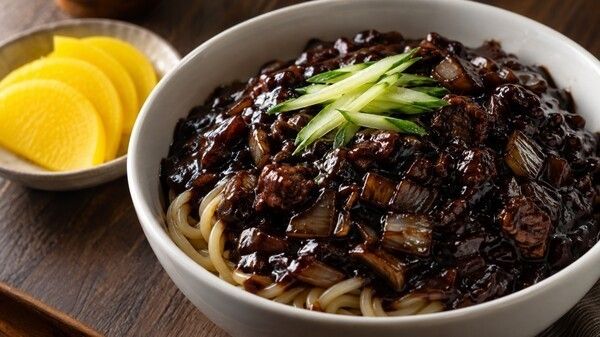
[News Culture] Jajangmyeon is one of those foods whose familiarity can obscure how unusual its history actually is. A mound of noodles disappears beneath a dark, glossy sauce, sweet onions soften into pieces of pork, and yellow pickled radish sits on the side. For generations of Koreans, the dish has been associated not only with Chinese restaurants but with moving day, graduation, office lunches, construction sites and the sound of a delivery motorcycle pulling up outside.
The dish traces its ancestry to northern Chinese zhajiangmian, particularly the noodle traditions of Beijing and Shandong, but modern Korean jajangmyeon has developed into something very different. Chinese zhajiangmian generally relies on a concentrated mixture of fermented paste and meat spooned over noodles, while Korean jajangmyeon uses a much larger volume of sauce built around chunjang, onions, pork, stock and starch. It is darker, sweeter and heavier, and those differences reflect nearly a century and a half of migration, industrial food production, state grain policy, urbanization and delivery labor. Jajangmyeon did not simply arrive in Korea; Korea remade it.
A Port City Creates the Conditions
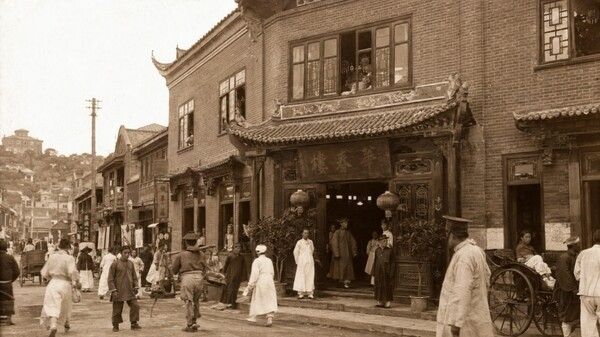
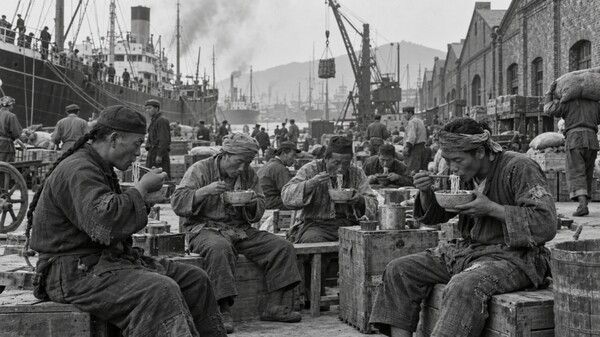
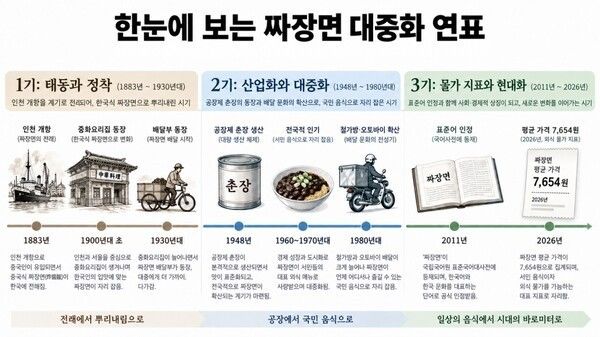
The story begins in Incheon. After the port opened in 1883, a Qing concession was established nearby and Chinese merchants, officials and workers began settling around the waterfront. Migration from Shandong increased from the mid-1880s, and the growing community supported lodging houses, stores and restaurants that served both residents and laborers around the port.
Food moved with that migration. Shandong workers ate simple noodle dishes dressed with fermented bean paste, while more elaborate Chinese cooking developed in restaurants serving wealthier customers and merchants. These food cultures overlapped in the same city, which is why the early history of jajangmyeon cannot be reduced to one dockside meal or a single restaurant kitchen. What is clear is that the first versions looked little like the black noodles Koreans know today: the sauce was lighter, closer to yellow-brown, and depended heavily on fermented pastes prepared by individual restaurants.
Why Gonghwachun Matters — and Why “First” Is Hard to Prove
No restaurant is more closely identified with the history of jajangmyeon than Gonghwachun in Incheon’s Chinatown. The old building in Seollin-dong, now used as the Jajangmyeon Museum, is an important surviving landmark of the city’s Chinese community and was designated a registered cultural heritage property in 2006. Its chronology, however, is less tidy than popular retellings suggest.
One record states that Yu Hee-gwang opened Shandong Hoegwan in Incheon in 1907 and changed the name to Gonghwachun around 1912. Other documentation shows Chinese residents jointly purchasing the current building in 1917, while Gonghwachun appears in a 1934 directory of Chinese merchants. The often-cited claim that the restaurant opened in 1905 therefore sits beside other dates in the historical record. Gonghwachun can be central to the history of Korean-Chinese cuisine without being treated as the proven birthplace of a dish created at one specific moment.
The Factory Did What the Restaurant Could Not
The modern bowl took shape when its sauce became industrial. In early Chinese restaurants, fermented paste was often made in-house, which meant flavor could vary dramatically from one establishment to another. Factory production changed that equation.
In 1948, Wang Song-san established Yeonghwa Jangyu in Seoul’s Yongsan district and began producing Lion Brand chunjang. Historical accounts differ on exactly when caramel coloring entered the recipe, with some placing the change in 1948 and others in the mid-1950s, but the broader effect is clear. Commercial chunjang made jajangmyeon darker, sweeter and far more consistent, while the use of onions, pork and starch-thickened liquid created the heavy black sauce that would become the dish’s visual signature.
Industrial production also narrowed the gap between restaurants. A customer no longer had to learn the taste of one kitchen; the same basic flavor profile could travel from neighborhood to neighborhood and city to city. That standardization was a critical step in turning jajangmyeon from a local Chinese-restaurant specialty into a mass-market food.
Then Korea Learned to Eat More Wheat
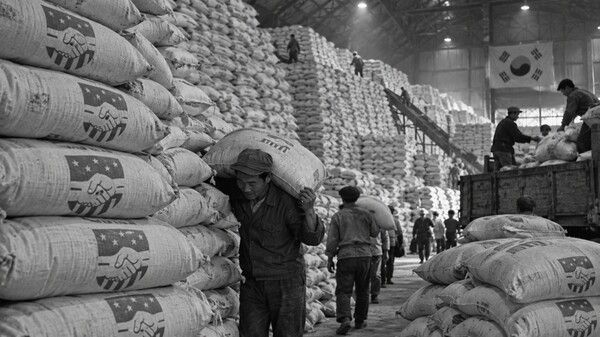
The next transformation had less to do with Chinese restaurants than with national food policy. After the Korean War, wheat flour became increasingly important to South Korea’s food supply, and in November 1962 the government intensified campaigns promoting mixed-grain and flour-based meals in an effort to reduce pressure on rice consumption.
Wheat use surged. Annual per-capita consumption rose from 13.8 kilograms in 1965 to 28.7 kilograms in 1969, more than doubling in four years. In 1969, Wednesdays and Saturdays were designated as “flour-food days,” and restaurants faced restrictions on selling rice dishes during certain hours. Jajangmyeon fit the moment almost perfectly: its noodles were made from wheat, it was inexpensive, quick to prepare and easy to serve at scale.
At the same time, Korean cities were growing and neighborhood Chinese restaurants were multiplying. The dish moved from an immigrant food tradition into the center of urban everyday life, becoming attached to social rituals of its own. Families ordered it while moving house, children ate it after graduation ceremonies, and workers relied on it for a quick restaurant meal. A government campaign designed around grain consumption had helped create the market conditions for one of Korea’s most recognizable foods.
The Real Revolution Arrived in a Metal Box
Jajangmyeon would not have become the same national institution without delivery. Korea already had a history of food delivery before the postwar Chinese-restaurant boom, with newspaper references to food delivery workers appearing as early as 1931, when meals were transported in wooden containers.
Technology gradually rewired the business. As household telephones spread in the 1960s, customers could order without visiting a restaurant. Metal delivery boxes became more common in the 1970s because they were lighter, easier to clean and better suited to repeated use, while motorcycles expanded delivery territory in the 1980s. Together, these changes effectively removed the walls of the restaurant: a small Chinese restaurant could serve an entire neighborhood without adding dining-room seats, turning apartments, offices, shops and construction sites into part of its customer base.
The metal box, cheolgabang in Korean, became so closely associated with Chinese-food delivery that it turned into a cultural shorthand for the job itself. The term spread widely through television in the late 1980s, although the boxes had already been used for years. Its significance was economic as much as nostalgic. Jajangmyeon traveled well, could be prepared quickly, stacked into reusable bowls and delivered cheaply over short urban distances, allowing the restaurant, motorcycle and delivery worker to function as an efficient neighborhood distribution system.
Today, much of that system has disappeared. App-based platforms now mediate the order, independent couriers have largely replaced restaurant employees, and disposable containers have replaced the old cycle in which bowls were delivered and collected later. Koreans still order jajangmyeon, but the infrastructure underneath the order is completely different.

Even the Word Became Korean
The language changed along with the food. For years, jajangmyeon was the only officially recognized Korean spelling, even though most people pronounced the word with the stronger initial consonant heard in jjajangmyeon. In 2011, jjajangmyeon was accepted as an additional standard form.
It was a fitting linguistic outcome. A name derived from Chinese had been reshaped by Korean speech in much the same way the dish itself had been reshaped by Korean ingredients and cooking methods.
From Cheap Lunch to Inflation Indicator
For much of the 20th century, jajangmyeon was synonymous with affordability. Historical price records place a bowl in Seoul at roughly 15 won in 1960, 60 won in 1971, 350 won in 1980 and around 1,400 won in 1991. Its price was also politically sensitive because the dish was regarded as an everyday food for ordinary households, and governments repeatedly treated it as an item to watch when trying to contain the cost of living.
That era is gone. By January 2026, the average price of jajangmyeon in Seoul had reached 7,654 won, up 2.1 percent from a year earlier. The 2025 annual average stood at 7,551 won, 4.1 percent above the 2024 figure of 7,253 won. A meal once used as shorthand for “cheap” is now regularly cited as evidence of how expensive eating out has become.
Its reach has also expanded beyond restaurants. Instant jajang noodles entered the market in 1970, helping turn the flavor profile into a major packaged-food category of its own.
One Bowl, Many Economies
There is no convincing way to explain jajangmyeon through a single inventor or anniversary. Its history belongs to several systems at once: migration rooted in Incheon’s Chinese community, industrial food production shaped by factory chunjang, agricultural policy tied to wheat consumption, urbanization powered by neighborhood restaurants, and delivery labor built around telephones, metal boxes, motorcycles and, eventually, digital platforms.
That combination is what made the dish Korean. Northern Chinese noodles supplied the starting point, but almost everything that now defines jajangmyeon — its black color, sweetness, abundance of sauce, price point and delivery culture — emerged from conditions inside Korea. The old Gonghwachun building and the dented metal delivery boxes preserved in museums are therefore more than relics of restaurant culture; they are evidence of how a foreign dish was absorbed into the machinery of modern Korean life.
Few meals make that history easier to see than a bowl of jajangmyeon.
Reported by News Culture M.J._mj94070777@nc.press
Copyright ⓒ 뉴스컬처 무단 전재 및 재배포 금지


