[News Culture] Brian Wildsmith’s paintings do not wait politely for a story to begin. Color arrives first.
Scarlet, cobalt, yellow and green push across the surface with an intensity that can overwhelm the animal, figure or landscape they ostensibly describe. At reproduction size, that energy often reads as the familiar brilliance of a children’s picture book. Standing before the originals, however, another Wildsmith appears.
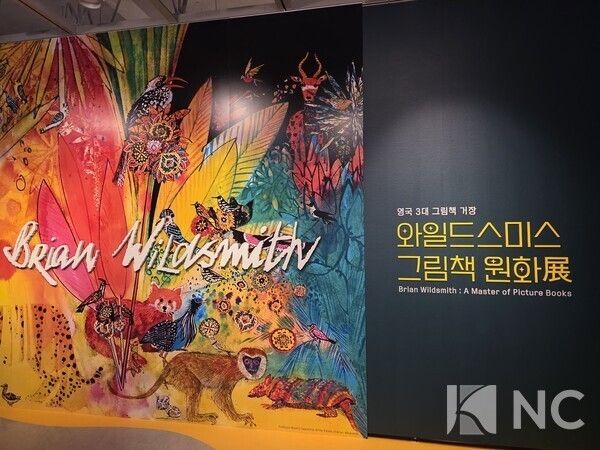
Paint sits heavily on paper. Cut sections have been pasted into place. Certain passages have been covered, corrected and painted again. Edges reveal decisions that disappear once the image is flattened into print. What seemed effortless on the page turns out to be built through repeated acts of construction.
That physicality is the key to Brian Wildsmith Original Art Exhibition, on view through Oct. 16 at the Seoul Calligraphy Art Museum in the Seoul Arts Center. Bringing together original illustrations, drawings and archival material spanning more than six decades, the exhibition makes a persuasive case that “picture-book illustrator” is too narrow a description for Wildsmith’s work.
Wildsmith, who lived from 1930 to 2016 and became one of Britain’s most celebrated picture-book artists, established his reputation with “ABC” in 1962. The premise could hardly have been simpler: a book for learning the alphabet. Its visual language was anything but.
The images do not behave as subordinate explanations of text. Animals and objects are pushed into dense fields of color, while scale, contour and surface create their own pictorial drama. The alphabet supplies the framework, but painting supplies the experience.
“ABC” earned Wildsmith the Kate Greenaway Medal in 1962. The honor is significant not simply as an early career milestone, but because it captures a shift taking place in postwar picture-book culture: illustration was increasingly capable of functioning as an autonomous visual language rather than as an obedient companion to prose.
Wildsmith pursued that possibility aggressively.
In books including “The Lion and the Mouse,” “The North Wind and the Sun” and “The Hare and the Tortoise,” familiar narratives become testing grounds for increasingly liberated combinations of color and form. His animals retain enough anatomical clarity to remain recognizable, yet naturalism rarely determines their palette.
A lion does not need to look like a lion found in nature. A landscape does not need to obey atmospheric perspective. Color is allowed to carry mood, rhythm and movement on its own terms.
Seen in person, the compositions can feel almost kaleidoscopic. Pigment presses against pigment. Decorative patterns crowd the surface. Lines sharpen or dissolve. In some works, the immediacy of the mark recalls brightly colored felt-tip pens; in others, dense layering gives the surface a weight closer to painting than commercial illustration.
The effect is fantastical without tipping into the grotesque. Wildsmith repeatedly places familiar creatures in visual worlds that are impossible yet emotionally accessible. His strangeness produces curiosity rather than dread.
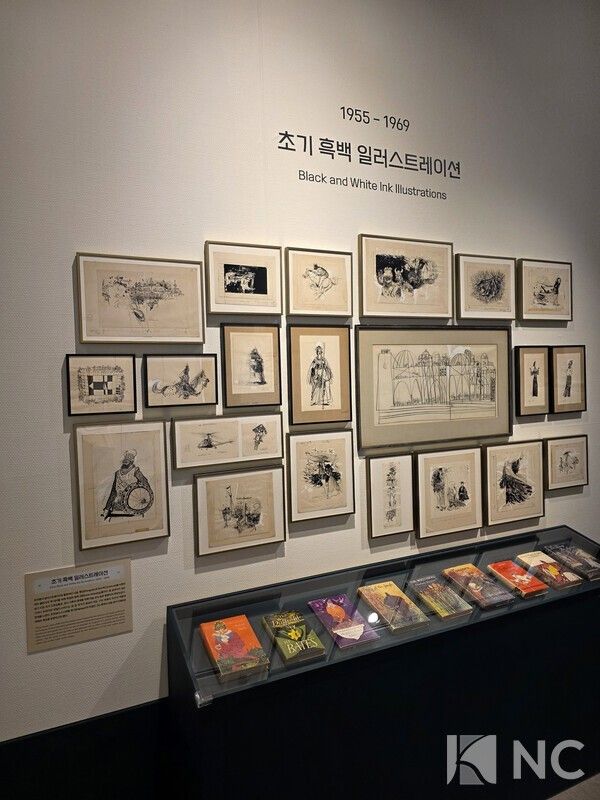
The exhibition becomes most interesting when it asks viewers to stop treating the works primarily as illustrations.
Once removed from the book, narrative function weakens and material decisions come forward. A spread that once served a fable can be read instead through balance, density, rhythm and chromatic tension. The eye begins to notice not what the image depicts, but how the surface has been organized.
This is where Wildsmith’s insistence on seeing himself as a painter becomes convincing.
The distinction is not semantic. Illustration is traditionally expected to serve something outside itself — a story, an educational function, a publishing format. Wildsmith repeatedly pushes against that hierarchy. His images may originate inside books, but many refuse to remain dependent on them.
Color carries its own logic. Composition establishes its own movement. Texture produces meaning before the accompanying text is read.
The originals also expose a productive tension at the heart of Wildsmith’s practice: he made highly material images while knowing that most viewers would encounter them as mechanically reproduced objects.
A 1978 interview included in the exhibition offers an important clue. Wildsmith discusses the technical demands of color printing and the risk that changes in scale or reproduction could compromise details. His decision to work close to the final dimensions of the published book was therefore more than practical efficiency. It was a way of controlling what survived the journey from studio to printing press.
That knowledge changes how one reads the corrections visible across the original works.
Cut-and-pasted areas, repainting and altered passages are not merely backstage evidence of trial and error. They demonstrate the precision required to make a handmade image function inside an industrial system of reproduction. Wildsmith’s paintings were conceived not only as singular objects, but as images that had to endure translation into ink, paper and mass circulation.
In that sense, the printed book was never separate from the artwork. It was part of its final form.
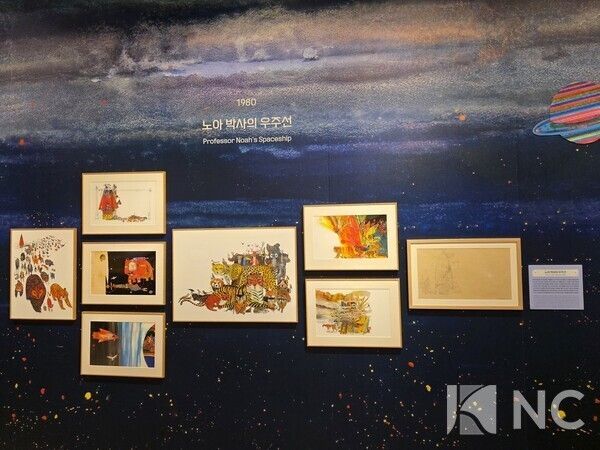
The exhibition also follows Wildsmith’s imagery beyond the page.
“Professor Noah’s Spaceship” is reworked as media art, setting animals and saturated color into motion accompanied by music. The environmental concerns of the original remain intact, but animation changes the hierarchy of the image. What was once controlled by the reader’s pace now unfolds in time.
The adaptation is revealing because movement does not feel foreign to Wildsmith’s compositions. His static images already contain an unusual amount of visual momentum. Animals surge across surfaces, colors collide and decorative forms seem ready to spill beyond the frame. Media art merely makes that latent motion explicit.
Wildsmith’s imagery also migrated into fashion and design. Liberty Fabrics incorporated motifs from his work into textile designs, while elements of his visual vocabulary later appeared on limited-edition Nike footwear. Images born inside picture books proved remarkably capable of surviving changes in scale, material and commercial context.
His 2013 collaboration with Samsung Electronics carries a different weight.
Created for a water-conservation campaign, the work recombined figures and motifs drawn from several earlier picture books into a new composition used across print and moving-image formats. It is regarded as Wildsmith’s final official commissioned work.
Here, quotation becomes self-quotation: decades of imagery are condensed into a late composite work, almost as though the artist were returning to his own visual archive.
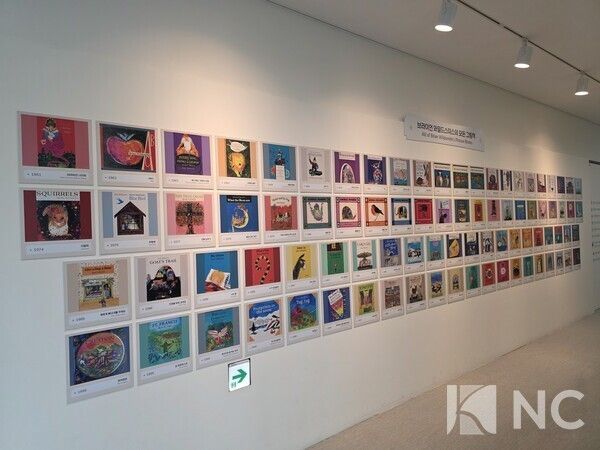
His final decades also point toward a more explicit dialogue with art history.
Travels through Assisi, Tuscany and Umbria intensified Wildsmith’s interest in Giotto, Duccio, Fra Angelico and Leonardo da Vinci. Religious subjects including Easter, St. Francis, Joseph, Moses, Jesus and the Virgin Mary allowed him to move toward more structured compositions and increasingly symbolic arrangements.
The chromatic intensity never disappears. What changes is the architecture surrounding it.
Earlier works often seem to expand outward, propelled by exuberant color and decorative density. Later pieces tend to gather that energy into firmer spatial structures. Figures become more hieratic, scenes more carefully staged, and the influence of devotional painting becomes easier to detect.
Seen across the full exhibition, this development complicates any simple division between Wildsmith the illustrator and Wildsmith the painter. The two practices were never truly separate. His late engagement with Renaissance and medieval art merely makes explicit what had long been embedded in the books: an intense concern with pictorial construction.
Yet children remain central to the philosophy behind the work.
Wildsmith resisted fixed interpretations and rejected the notion that a child could give a “wrong” response to an image. The picture was not a puzzle with a predetermined solution. It was a space in which perception and imagination could move freely.
That openness may explain why his work has aged differently from many works of didactic children’s illustration. It does not merely instruct. It invites prolonged looking.
The exhibition attracts many families, predictably enough, but the most revealing way to approach it may be to temporarily forget that these images came from children’s books at all.
Look instead at the pressure of the paint. The collision of complementary colors. The seams where paper has been added. The reworked passages that remain visible beneath the final image. Look at how a figure is positioned within a field, how decorative detail destabilizes depth, how color can turn a recognizable animal into something approaching abstraction.
The printed picture book transforms these things into a seamless experience.
The original restores their friction.
For viewers who knew Wildsmith through books, the exhibition may initially operate through nostalgia. That feeling does not last long. The originals are too physical, too deliberate and too pictorially ambitious to remain souvenirs of childhood reading.
They demand to be looked at as objects.
And that is where the exhibition finds its strongest argument. Wildsmith did not simply bring painting into the picture book. He used the picture book as one of the places where painting could continue to reinvent itself.
Reported by News Culture M.J._mj94070777@nc.press
Copyright ⓒ 뉴스컬처 무단 전재 및 재배포 금지


