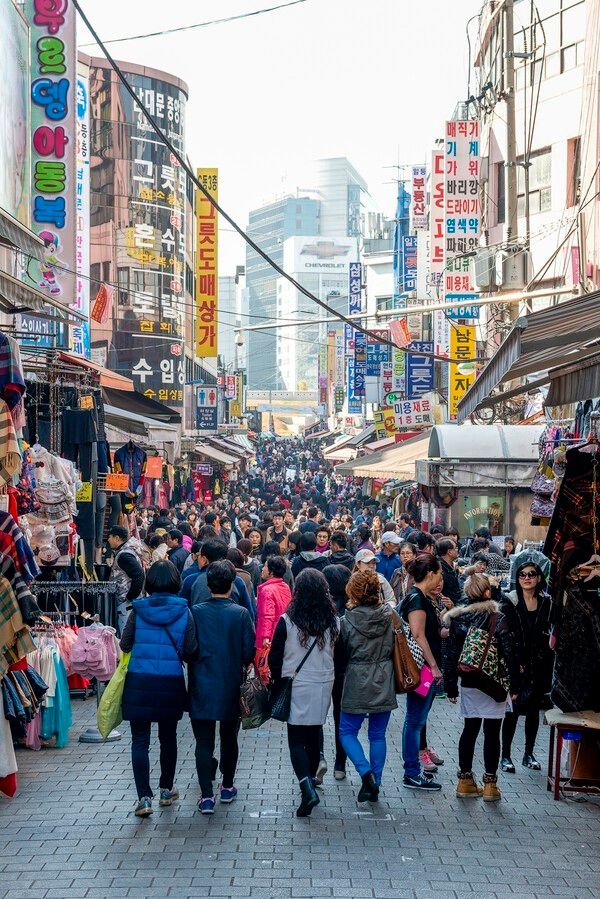
[News Culture] Before most of Seoul has opened its doors, Namdaemun Market is already in motion.
Wholesalers haul bundles through narrow lanes before dawn. Office workers and travelers take over by lunchtime. Later, shoppers drift between kitchenware stores, accessory arcades and food stalls.
The cast changes by the hour, but the market rarely stands still.
For six centuries, Namdaemun has repeatedly remade itself around the needs of the city. It grew from a late-Joseon seafood market into a national wholesale hub, survived colonial control and wartime destruction, then found new life through fashion, accessories, street food and tourism.
According to Statistics Korea, the market spans 66,116 square meters and contains 10,172 stores selling more than 1,700 categories of goods. The numbers suggest scale, but they do not fully explain its endurance. Namdaemun has lasted because it has never remained only one kind of market.
■ How Fish Built Chilpae
Namdaemun Market traces its roots to Chilpae, one of the largest commercial districts in late-Joseon Seoul.
Licensed merchants in Jongno once held exclusive trading rights in return for supplying government offices. As the capital expanded, however, those privileges became harder to enforce. Independent traders, street vendors and wealthy private wholesalers moved into the gaps.
Chilpae near Seosomun and Ihyeon near Dongdaemun emerged as powerful alternatives to the state-regulated shops of central Jongno.
Geography worked in Chilpae’s favor. The southern side of the capital was closely connected to the river ports of Mapo and Yongsan, making it a natural entry point for seafood shipped north from Korea’s southern provinces.
Major merchants sent buyers to ferry crossings and roadside trading posts before the catches reached the city. Fish and dried seafood were then redistributed across Seoul and carried deep into inland regions.
Old records describe heaps of fish piled around Hoehyeon-dong and Jujadong, with the smell hanging over the neighborhood. The image is unglamorous, but it captures the market’s scale and energy.
Seafood soon gave way to rice, cotton cloth and other daily necessities. Chilpae eventually stood alongside Jongno and Ihyeon as one of Seoul’s three leading commercial districts.
Prosperity also attracted its share of disorder. Stories spread of counterfeit silver, poor-quality fur sold as luxury goods and pickpockets moving through the crowds. Chilpae was a place where fortunes could be made, but also where buyers had to keep their wits about them.
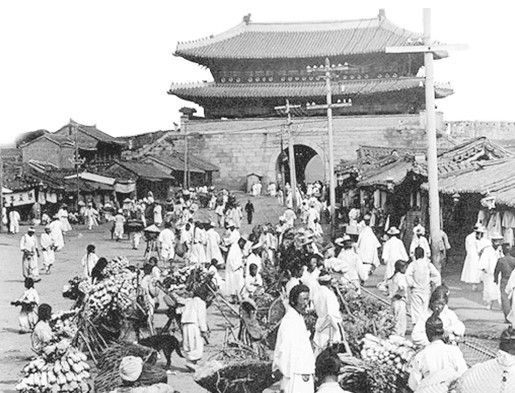
■ Commerce Under Colonial Pressure
Japanese businesses began moving into the area soon after Korea opened its ports.
Backed by stronger financing and institutional support, they expanded from the foot of Namsan toward Sungnyemun. Imported petroleum, cotton yarn, cigarettes and Western confectionery entered the market, while gold dust and premium Korean red ginseng flowed out to Japan.
The pressure was particularly acute in the seafood trade. Japanese-controlled fisheries companies and distribution centers steadily weakened the networks local merchants had built over generations.
Control of the market itself later passed to operators aligned with the colonial administration. Transaction volume increased, but so did rents and fees. Merchants paid more while roofs leaked and aging facilities went unrepaired.
Monthly stall charges rose nearly fivefold between the early 1920s and 1936. Even roadside vendors were brought into the fee system.
Korean merchants organized in response. Around 120 members pooled emergency funds and demanded protection for their livelihoods. Their campaign could not stop the colonial government from reshaping Seoul’s wholesale system, but it showed that Namdaemun was more than a cluster of shops. It was a community willing to defend its place in the city.
The market continued to trade through the upheaval. Rice, fruit, vegetables, meat and household goods filled its stalls, joined by newer foods such as fish cakes, Japanese-style soy sauce and castella.
Dried seaweed sales rose more than thirtyfold in the seven years following 1926, foreshadowing a product that would remain closely tied to Korean food commerce for decades.
■ From Ruins to the Dokkaebi Market
Liberation brought returning Koreans, refugees from the North and a sudden surge in demand for everyday goods.
It also brought disputes over shops and buildings formerly controlled by Japanese residents and companies. A merchants’ association secured formal management rights in 1952, but the Korean War soon reduced the district to rubble.
By the time the armistice was signed, almost no building remained intact.
The merchants came back anyway.
They rebuilt with wooden shacks, open-air stalls and whatever materials they could find. Street vendors from nearby Bukchang-dong joined them, and by around 1953 hundreds of businesses were operating again.
Postwar Namdaemun traded in the goods of survival. American relief supplies and products diverted from U.S. military bases moved quietly through the alleys: cameras, watches, military uniforms, combat boots, blankets and boxes of field rations.
When police inspectors appeared, unauthorized stalls could vanish within moments. Their ability to disappear and re-emerge gave the market one of its most enduring nicknames: the Dokkaebi Market, or “Goblin Market.”
Other names reflected the people and products that filled its streets. American goods inspired “Yankee Market,” while the concentration of refugees from Hamgyong Province gave rise to “Abai Alley.”
Fire repeatedly threatened what the merchants had rebuilt. A major blaze in 1954 destroyed around 1,000 shops. Another in 1968 burned through 775 stores and neighboring commercial blocks.
The losses were devastating, but reconstruction followed. Reinforced-concrete buildings replaced many of the makeshift structures, and hundreds of new shops opened during the following decade.
By the mid-1970s, daily foot traffic had climbed above 150,000. Around 60 percent of the market’s workers were people displaced from North Korea, making Namdaemun not only a commercial center but also a place where uprooted communities rebuilt their lives.
■ When “Nammun Fashion” Set the Pace
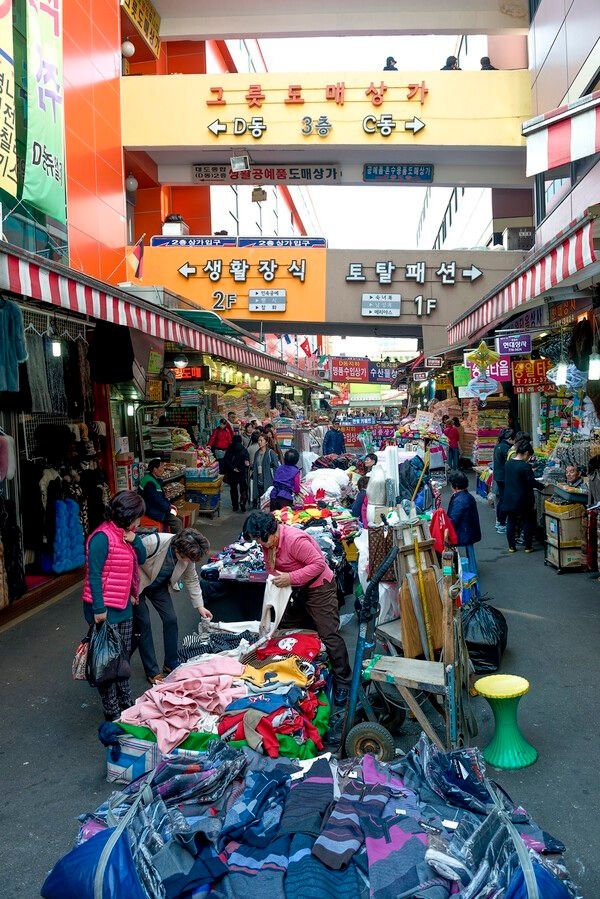
Ready-to-wear clothing transformed Namdaemun in the 1980s.
Before sunrise, retailers arrived from across the country by overnight train and express bus. They packed garments into large sacks and returned home to restock their own shops.
The alleys rang with dialects from every region of Korea. Namdaemun was no longer simply a Seoul market. It had become part of a national distribution system.
Clothing produced and sold there became known as “Nammun fashion,” a label influential enough to shape trends nationwide.
During the 1988 Seoul Olympics, daily visitor numbers reportedly approached 600,000.
As fashion wholesaling lost some of its dominance in the 1990s, accessories moved into the space it left behind. Shops specializing in earring backs, pendants, brooches and hairpins multiplied, turning Namdaemun into a major production and wholesale center.
Other trades formed their own tightly organized districts. Tableware for newlyweds, custom eyewear, professional cameras, designer bags, imported goods and kitchen supplies each developed a distinct cluster.
That specialization still defines the market today.
Before dawn, wholesalers set the pace. At midday, office workers and travelers crowd into the food alleys. In the afternoon, retail shoppers browse cookware, scarves, gifts and accessories.
Overseas visitors often leave with seasoned seaweed, red ginseng, vacuum-packed kimchi or handmade leather goods. Their appeal is practical as well as cultural: they are easy to carry, easy to share and unmistakably tied to Korea.
■ Where the Market’s History Reaches the Table
Namdaemun’s food alleys are now as important to its identity as its shops.
Travelers may arrive with a shopping list, but the smell of simmering stew, hot broth and fried dough often changes the plan.
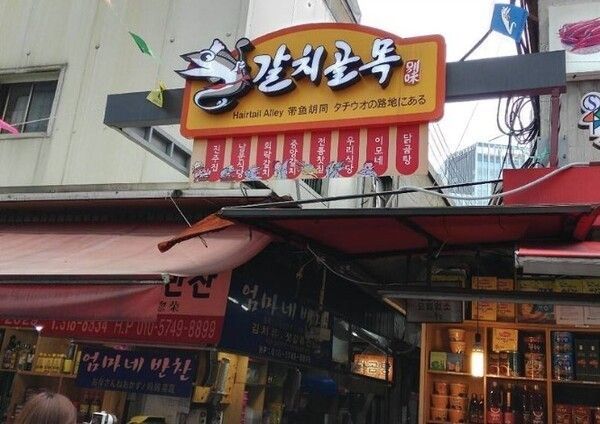
The braised hairtail alley began taking shape around 1988. Two restaurants, Huirak and Wangseong, turned a familiar fish dish into a neighborhood specialty. As customers arrived, nearby restaurants followed.
The success of the dish carries a historical echo. Chilpae once prospered by distributing fish across the capital. Centuries later, the same district draws crowds by cooking it.
What began as an affordable lunch for merchants and office workers has become a fixture on Seoul food tours.
The kalguksu alley offers a different kind of generosity.
Customers ordering barley rice often receive small servings of hand-cut noodles and spicy cold noodles. Those choosing kalguksu may be served bibimbap and cold noodles alongside it.
A single order rarely remains a single dish.
The narrow counters and shoulder-to-shoulder seating are part of the appeal. Meals arrive quickly, portions multiply and strangers share the same crowded space. For overseas visitors, the alley offers an immediate encounter with the rhythm of Korean market dining.
Outside, the streets provide another menu: seed-filled hotteok, dumplings, skewered fish cakes, glutinous rice cakes, sundae and mung bean pancakes.
Vegetable hotteok has become a particular favorite. Filled with glass noodles and chives, then fried until crisp, it offers a savory alternative to the sweeter version found elsewhere.
■ A Market Woven Into the City
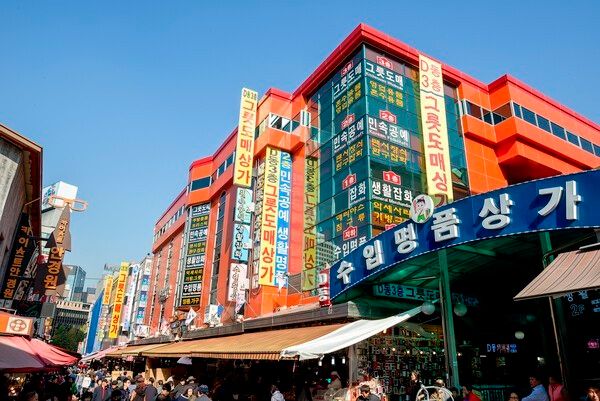
Namdaemun sits at the center of a wider historic district rather than apart from it.
Hoehyeon Station opens directly into the market, while Seoul Station, City Hall and Euljiro are all within walking distance. Sungnyemun Gate stands nearby, with Deoksugung Palace, the Seoul Museum of Art and Namsan extending the route in different directions.
A visitor can begin with kalguksu in the morning, browse accessories and tableware after lunch, pick up seaweed or red ginseng, then leave the market through the shadow of Sungnyemun.
The journey may take only a few hours, but the neighborhood carries several eras at once.
The fish merchants of Chilpae, the traders who resisted colonial control, the refugees who rebuilt from ashes and the wholesalers who once set Korea’s fashion trends all remain part of Namdaemun’s identity.
Its appeal does not lie in preserving the past untouched. Namdaemun has survived by allowing every generation to reshape it.
That may be why the market still feels less like a monument than a living part of Seoul: crowded, adaptable and always moving toward its next life.
Reported by News Culture M.J._mj94070777@nc.press
Copyright ⓒ 뉴스컬처 무단 전재 및 재배포 금지


