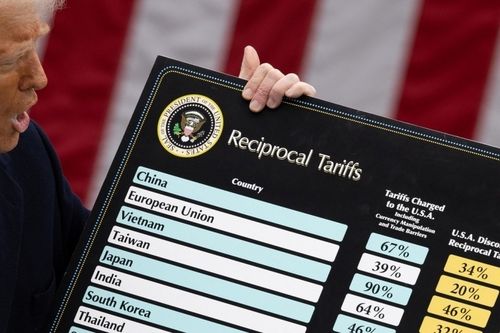
In the wake of the Trump administration's aggressive tariff policies, global economic recovery appears to be faltering, as highlighted by the latest findings from the "Tracking Indexes for the Global Economic Recovery" (TIGER index), released by the Brookings Institution and the Financial Times. The global TIGER index fell to 5.950 in April, marking a decline for the second consecutive month since its February peak of 7.710.
The index, which evaluates global economic recovery through various economic, financial, and confidence indicators, reveals a concerning dip in the global confidence index, which has decreased for three straight months to -1.044. The financial index also fell for the second month in a row to 7.144, indicating a growing sense of unease in financial markets.
Brookings Institution researchers, including Eswar Prasad, have warned that the risk of a policy-induced global recession is rising sharply due to heightened financial market volatility and policy uncertainty. This comes as the global economy was showing signs of stabilization, making the timing particularly detrimental.
While macroeconomic indicators have shown some resilience, the negative signals from financial and confidence indices reflect the disruption caused by U.S. tariff policies on global trade and financial markets. These policies have dampened growth prospects that seemed promising earlier in the year.
South Korea has also felt the effects, with its confidence index slipping back into negative territory at -1.426, after a brief recovery in February and March. The country's financial index plummeted to -3.441, its lowest since March 2023.
In the United States, despite strong production and employment figures through the first quarter, the economic outlook shifted following President Trump's announcement of reciprocal tariffs on April 2. Stock market volatility, weakened consumer confidence, and the potential limitation on interest rate cuts due to tariff-induced inflation are adding to the economic uncertainty.
The Chinese economy, meanwhile, is facing its own challenges. The ongoing trade tensions with the U.S. and deflationary pressures from oversupply are making it vulnerable to a full-scale trade war. This dual threat is expected to negatively impact emerging markets, particularly in Southeast Asia.
Despite these challenges, researchers caution that a global recession is not imminent, though the collapse of global trade and rising policy uncertainty are likely to restrain growth. The International Monetary Fund (IMF) is set to release its World Economic Outlook on April 22, which is anticipated to incorporate the effects of these tariffs. IMF Managing Director Kristalina Georgieva has indicated that the new forecast will feature a noticeable downward revision in growth expectations, though it will stop short of predicting a recession.
Copyright ⓒ 뉴스로드 무단 전재 및 재배포 금지
본 콘텐츠는 뉴스픽 파트너스에서 공유된 콘텐츠입니다.


